

Lesson
Dashboard
Lesson 1
Family Data File
Lesson 2
Attendance
Lesson 3
Family Selection & Enrollment Activities
Lesson 4
Parent Involvement & Education
Lesson 5
Health & Social Services
Lesson 6
Expulsion & Suspension
Lesson 7
Community Involvement
Lesson 8
Site Licensure & License Exempt
Lesson 9
Staff-Child Ratios
Lesson 10
Environment Rating Scale
Lesson 11
Nutritional Needs
Lesson 12
DRDP & Education Program
Lesson 13
Parent Survey
Lesson 14
Qualified Staff & Director
Lesson 15
Staff Development
Lesson 16
Refrain from Religious Instruction
Lesson 17
Inventory Records
Lesson 18
Program Self-Evaluation
Lesson 19
Contractor Parent Policies
Lesson 20
Fiscal

Introduction to Reimbursement
Contracts are reimbursed in monthly apportionment amounts, which are determined by Child Development Fiscal Services (CDFS) according to projected earnings calculated from the contractor’s Enrollment, Attendance, & Fiscal Report data.
Reference
Watch Video Lesson ❯
Accessibility Note: The complete accessible content is available in the video and transcript below. The transcript can be accessed using the transcript option in the video player controls. The slide deck is provided for visual reference and may not be fully accessible.
Video Description: This video discusses contract reimbursement and apportionments as it relates to a center-based CDSS program.
Sample Forms/Tools ❯
Review Sketch Pad Notes ❯
Reporting
Accurate and timely reporting is essential to maximizing earned reimbursement, maintaining compliance with contract requirements, and reducing the risk of funding delays, audit findings, or repayment of funds.
The Enrollment, Attendance, and Fiscal Report is the primary report used to determine a contractor's reimbursement.
Reporting Deadlines

Contractors are required to submit monthly or quarterly attendance & fiscal reports depending upon their contract.
Monthly reporting is required for “Contractors on conditional or provisional status”. For all other contractors, attendance reports are submitted quarterly for the periods ending.
Reports are due by the 20th of the month following the end of the reporting period. Attendance data is submitted online within the Child Development Program Enrollment Attendance and Fiscal Reporting System (CDPR).
Reports NOT received or that are incomplete are delinquent & apportionments will be withheld.
Reimbursement
Limits of Reimbursement

Beginning Fiscal year 2026-2027, contractors will be reimbursed based on the 3 limits of reimbursement:
Contract Maximum Reimbursable Amount:
Maximum amount available under the contract, also known by the acronym MRA
Net Reimbursable Program Costs:
Reflects a contractor’s allowable program expenses after applicable revenue and adjustments are considered
Service Earnings
Calculated by multiplying the adjusted child days of enrollment for certified children by the contract reimbursement rate
What might this look like in a program:
2026-2027 Example:
Scranton Community Action Agency has a Maximum Reimbursable Amount or MRA of $850,000.
The total Service Earnings for the year totaled $800,000 while their Net Reimbursable Expenses totaled $845,000
Based on the above, Scranton will be reimbursed $800,000 as the service earnings were less than the maximum reimbursable amount.
Scranton Community Action Agency will need to explore other funding sources such as tapping into their reserve account to cover the excess expenses of $45,000 that will not be reimbursed.
Service Earnings & Funded Enrollment

To fully earn a contract through service earnings, contractors should estimate how many enrolled children their contract's Maximum Reimbursable Amount (MRA) can support.
Funded Enrollment Calculation Formula:
MRA ÷ Contract Rate ÷ Adjustment Factor ÷ Minimum Days of Operation (MDO) = Full-Time Equivalent (FTE) Children
This calculation provides a starting estimate of the number of children needed to fully earn a contract. Actual service earnings, however, are based on the adjusted child days of enrollment for certified children multiplied by the contract rate.
What are Child Days of Enrollment (cdes)?
Child days of enrollment or cdes, is the total of every child’s enrollment for the days the contractor is open to provide services. Enrollment for each child depends on certified enrollment which is reflected on the Notice of Action.
What might this look like in a program:
Dunder Mifflin Child Development Center has a MRA of $820,000.
Start with the MRA: $820,000
Divide by the contract rate: $54.93
Divide by the full-time adjustment factor: 1.0
Divide by the minimum days of operation: 246
$820,000 ÷ $54.93 ÷ 1.0 ÷ 246 = 61 FTE children
Based on this calculation, Dunder Mifflin CDC would need approximately 61 full-time equivalent children enrolled to fully earn its contract through service earnings.
Emergency Closure

If a contractor temporarily closes a site, classroom, or FCCHEN-affiliated family child care home due to circumstances beyond the contractor’s control, the contractor must submit an Emergency Closure Request Form to their assigned PQI Consultant.
The approved request is required to receive credit for reduced days of operation and child days of attendance connected to the closure.
NOTE: Days of operation are credited only when all sites under the contract are closed and no children are served on a scheduled day.
Contractors must keep the approved form on file for audit purposes and report the approved credits on their fiscal and attendance reports.
Apportionments
Apportionments are advanced to contractors on a monthly basis determined by the Child Development Fiscal Services (CDFS) according to projected earnings calculated from the contractor’s Enrollment, Attendance & Fiscal Reports data submitted through CDPR.
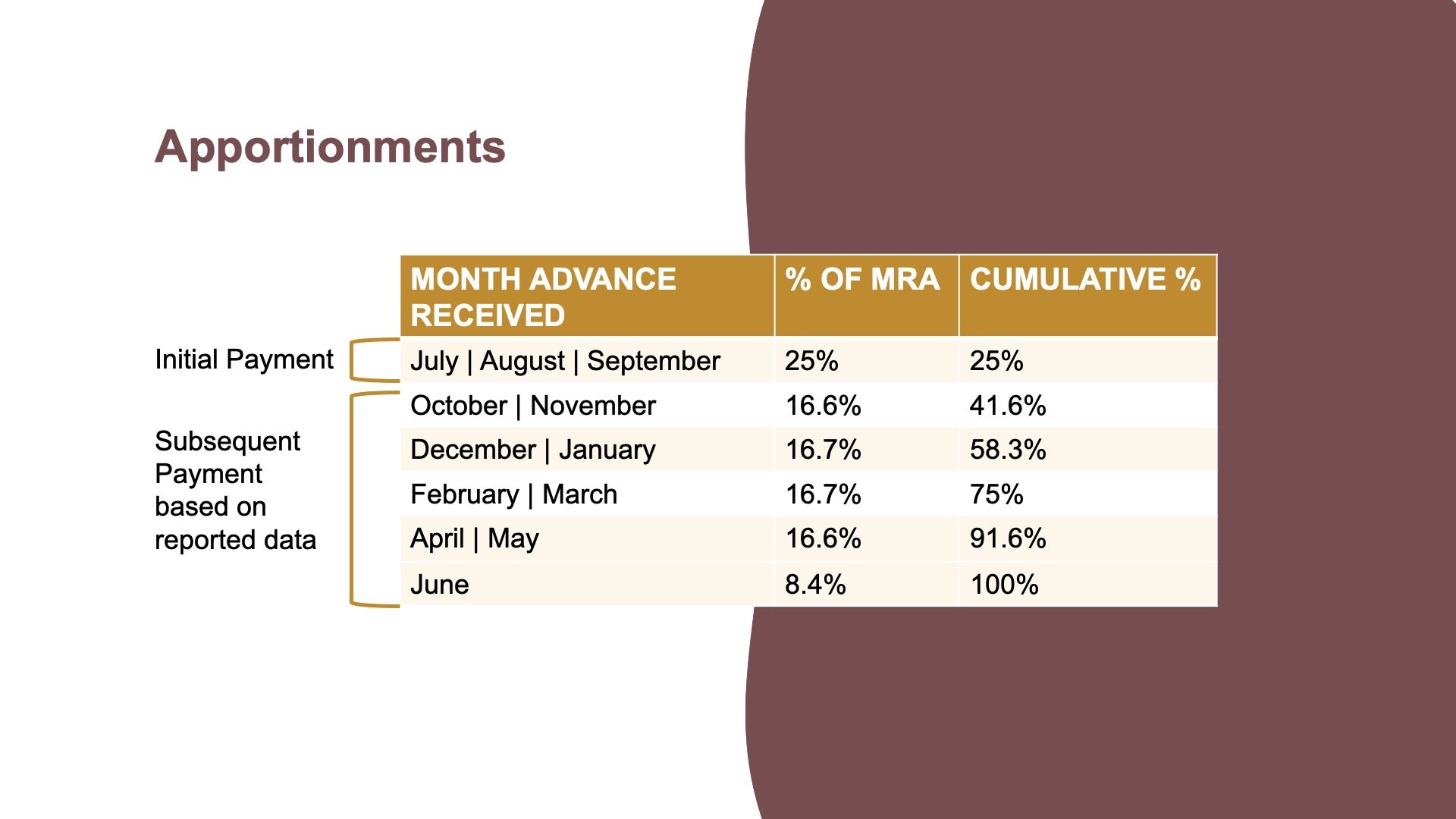
After initial payment, subsequent payments are based on reported data in CDPR.
To determine the payment, the contract earnings are multiplied by the maximum cumulative % applicable for that month or months, minus any apportionments paid to date.
Contractors will receive funds via the State Controller’s Office (SCO) through electronic fund transfer or paper checks.
To support electronic payments, contractors should establish and maintain their payment information through the Supplier Information Management (SIM) system within the Coupa Supplier Portal, overseen by the Financial Information System for California.
Conclusion
Notification Letters

After reports are submitted by the agency, Fiscal Services provides a notification letter along with earning calculation worksheet regarding the upcoming apportionment:
Preliminary Review Letter: Sent to contractors who are projected to earn their contract
Apportionment Adjustment Letter: Sent to contractors whose apportionment is reduced because the contractor is not projected to fully earn the MRA; also serves as a warning of potential fiscal or enrollment issues
Apportionment Withhold Letter: Sent to contractors whose apportionment is entirely withheld due to noncompliance with contract requirements
NOTE: Regardless of the letter received, contractors should carefully review the earnings calculations worksheet to address any possible overspending or enrollment problems & make adjustments as needed.
Year-End Calcuation

Year-end reports are calculated at the end of the Fiscal year to determine a contract’s total reimbursement. The year-end calculation may result in one of the following:
No additional payments due to the contractor if the contractor fully earned the contract
Calculated billing due to over-advancement of contract funds as a consequence of not earning the contract
If the year-end calculation results in a billing, the contractor will receive a Preliminary Billing Notification along with the calculation worksheet.
What this might look like in a program:
Upon notification of a calculated billing, the contractor should review the previously submitted report data for accuracy.
Ensure any approved Emergency Closures are included within your reports.
Complete Knowledge Check ❯
After reviewing the video lesson & sketch pad notes, it’s time to check for understanding by completing a Knowledge Check. Note that Individual Knowledge Checks will conclude with a Certificate.