

Lesson 2
Family Data File
Lesson 3
Attendance
Lesson 4
Parent Engagement & Strengthening
Lesson 5
Health & Social Services
Lesson 6
Expulsion & Suspension
Lesson 7
Community Involvement
Lesson 8
Site Licensure & License Exempt
Lesson 9
Staff-Child Ratios
Lesson 10
Classroom Assessment System
Lesson 11
Nutritional Needs
Lesson 12
Desired Results Profile & Data
Lesson 13
Parent Survey
Lesson 14
Staff Qualifications
Lesson 15
Staff Development Program
Lesson 16
Refrain from Religious Instruction
Lesson 17
Inventory Records
Lesson 18
Program Self-Evaluation
Lesson 19
Contractor Parent Policies
Lesson 20
Fiscal
Lesson 21
Data Reporting

Requirement
Families with children enrolled in the program have met the eligibility requirements of that contract, & the required documentation is complete. A family data file has been established for each family, including a completed application for services & supporting documentation.
For part-day CSPP, once certified a child shall be deemed eligible for the remainder of the program year & for the following program year, as long as applicable age-eligibility requirements are met.
Regulations/Reference
EED Program Instrument: I. Family Files EED 02, & 05
Title 5: 17758
Monitoring Review Evidence
Application for Services & Information Verification
Records of Eligibility, Residency & Family Size
Records of Verification of Eligibility Information
Written Materials for Parents
Watch Video Lesson ❯
Video Description: This video explains what needs to be in a Family Data File for families enrolled in a Part-Day State Preschool program.
Sample Forms/Tools ❯
File Checklists
Parent Enrollment Checklists/Tools
Family Data File Monitoring Tool

Review Sketch Pad Notes ❯
Family Data File (CSPP Program)
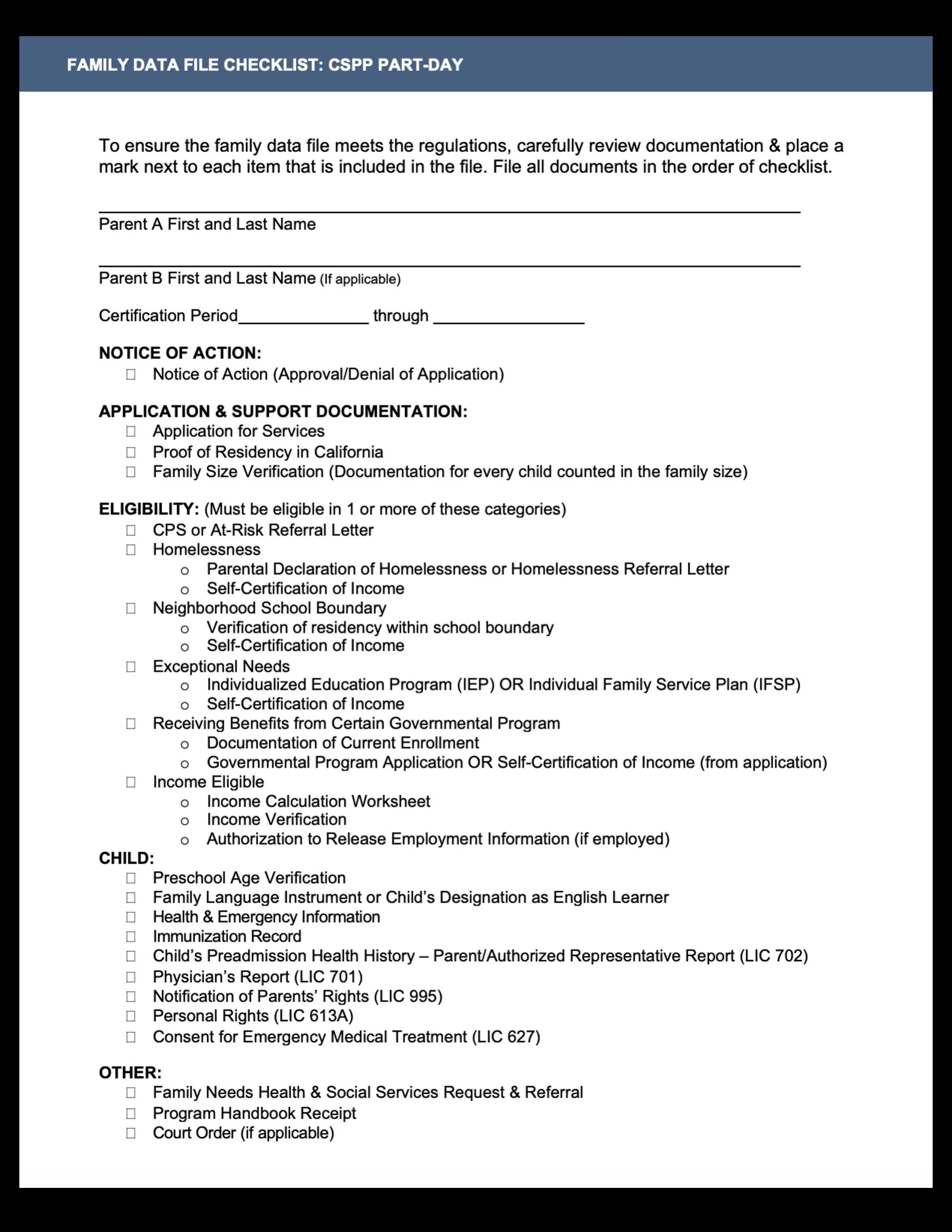
A family data file must be established for each family receiving State Preschool services, including a completed application for services and supporting documentation.
What this might look like in a program:
Family provides documentation based on the Parent Enrollment Checklist that includes what is needed for the CSPP program, along with what is needed for child care licensing
Enrollment Specialist reviews documentation to determine if it meets the requirements
Enrollment Specialist completes an Application for Services based on supporting documentation. The application is then reviewed with the parent. Parent signs confirming their information is correct
Enrollment Specialist issues an approval or denial Notice of Action
Enrollment Specialist organizes the file based on the Family Data File Checklist
Alternating Residence
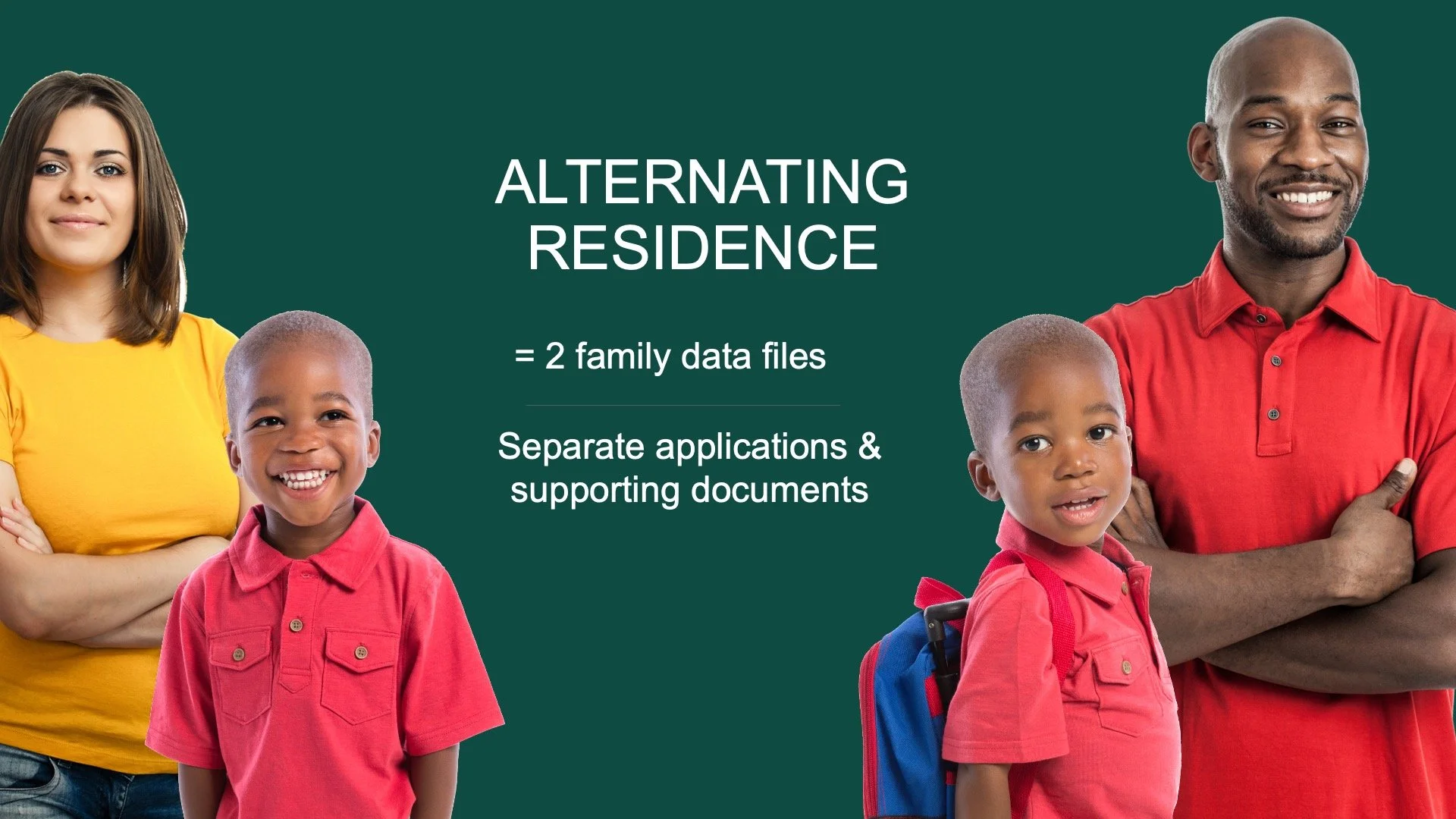
When a child’s residence alternates between the homes of separated or divorced parents, eligibility must be determined separately for each household during the time the child is residing in that home and services are needed.
Example:
A child lives with their mother one week and their father the next. Both parents request preschool services during the time the child is in their care.
Because the child resides in two separate households, each parent must complete their own application. This includes creating two separate family data files and submitting all required supporting documentation for each household.
Foster Parent/Guardian

When a child and their siblings are living in a family that does not include their biological or adoptive parent, the “family” is defined as the child and their related siblings.
Example:
In one household, there are three separate families:
First family: One unrelated foster child
Second family: A married couple with one child
Third family: Two siblings who are foster children
If all children in this household are enrolled, three separate family data files must be created. Each family must complete its own application and provide all required supporting documentation.
Proof of Residency

Families enrolled in a subsidized program must live in California; therefore, the state requires programs to have proof of residency in the family data file.
Evidence of a street address or post office address
Homeless may submit declaration that they reside in California
Determination of eligibility shall be without regard to the immigration status of the child or the child's parent(s), unless under a final order of deportation from the United States Department of Homeland Security
NOTE: If family’s eligibility is the CSPP Neighborhood School, additional proof of residency may be required (For more information see section “Documentation of Eligibility: CSPP Neighborhood School”)
Health & Emergency Information

The family data file must include all child health & current emergency information required by California Code of Regulations and a copy of the Immunization Records.
NOTE: For sites licensed by Community Care Licensing, additional documentation is required:
Child’s Preadmission Health History - Parent’s Report (LIC 702)
Physician’s Report (non-school age only) (LIC 701)
Parent’s Rights Form (LIC 995A)
Personal Rights Form (LIC 613A)
Consent for Emergency Medical Treatment Form (LIC 627)
Child with Disabilities

If a child’s eligibility is based on having a disability, documentation is required to verify that eligibility.
The file must include current documentation, such as:
Individualized Family Service Plan (IFSP), or
Individualized Education Program (IEP)
The documentation must include the relevant section(s), such as the front page, that clearly identify the child and confirm eligibility.
Court Order

If a family has a court order that affects the provision of preschool services (e.g., custody arrangements, authorized pick-up, or decision-making authority), a copy of the court order must be included in the family data file.
Only the relevant pages of the court order need to be included, provided they clearly show the information that impacts services.
File System

As you build a family data file, think of it as telling the family’s story through documentation. Anyone who reviews the file should be able to clearly understand the family’s eligibility.
Make no assumptions.
Organize documentation. Use a File Checklist as a guide to set up each file.
Include case notes for unique situations or special requests.
When applicable, include staff attestations.
Note: If a document in the family data file is used to verify multiple eligibility criteria, it is best practice to clearly indicate what it supports.
For example, a pay stub that includes an address may be used to verify both income eligibility and residency. Add a note on the document stating: “Proof of income eligibility and residency.”
Monitoring Tool: Family Data File

A Family Data File Monitoring Tool is used to review work and provide ongoing training related to the components of a Family Data File.
Ideas for using this monitoring tool:
After completing all training related to the Family Data File, new employees should review multiple files to better understand how all components come together.
On a quarterly basis, enrollment staff and supervisors should randomly select Family Data Files for review. This process supports quality assurance and provides an opportunity for hands-on training at all staff levels.
Sample Guidelines:
Cross-review files (review coworkers’ files, not your own).
Establish ground rules that encourage open and respectful conversation (e.g., a “no judgment” environment).
Maintain a clear purpose: To collaborate, learn as a team, and identify areas that may need adjustment or additional support.
Complete Knowledge Check ❯
After reviewing the video lesson & sketch pad notes, it’s time to check for understanding by completing a Knowledge Check. Note that Individual Knowledge Checks will conclude with a Certificate.