
Lesson 10
Classroom Assessment System
Lesson 11
Nutritional Needs
Lesson 12
Desired Results Profile & Data
Lesson 13
Parent Survey
Lesson 14
Staff Qualifications
Lesson 15
Staff Development Program
Lesson 16
Refrain from Religious Instruction
Lesson 17
Inventory Records
Lesson 18
Program Self-Evaluation
Lesson 19
Contractor Parent Policies
Lesson 20
Fiscal
Lesson 21
Data Reporting
Compliance Indicator
Contractors are required to use the CLASS® Second Edition Pre-K–3rd and CLASS Environment™ tools to observe State Preschool classrooms. CLASS® shall be implemented with a graduated phase-in approach beginning in 2024–25.
Regulations/Reference
Education Code: 8207, 8208, 8231 & 48000
Management Bulletin 23-10
CDE Classroom Assessment Resource Page
Monitoring Review Evidence
CLASS® assessment results and score sheets
CLASS Environment™ assessment results and score sheets
Watch Video Lesson ❯
Accessibility Note: The complete accessible content is available in the video and transcript below. The transcript can be accessed using the transcript option in the video player controls. The slide deck is provided for visual reference and may not be fully accessible.
Video Description: This video provides an overview of the classroom assessment system through the use of CLASS® & CLASS Environment™ in a State Preschool program.
EXTERNAL TRAINING NOTE:
Educator training/coaching opportunities for both CLASS® and CLASS Environment™ may vary from one agency to another. For example training/coaching opportunities may include:
Regional Leads hosting trainings at a local level (in-person and/or virtual)
In-house training and coaching
Online learning through Teachstone®. The following online courses are recommended for Teachers/Educators:
Sample Forms/Tools ❯
CLASS® Resources
Environment Resources
Review Sketch Pad Notes ❯
Overview
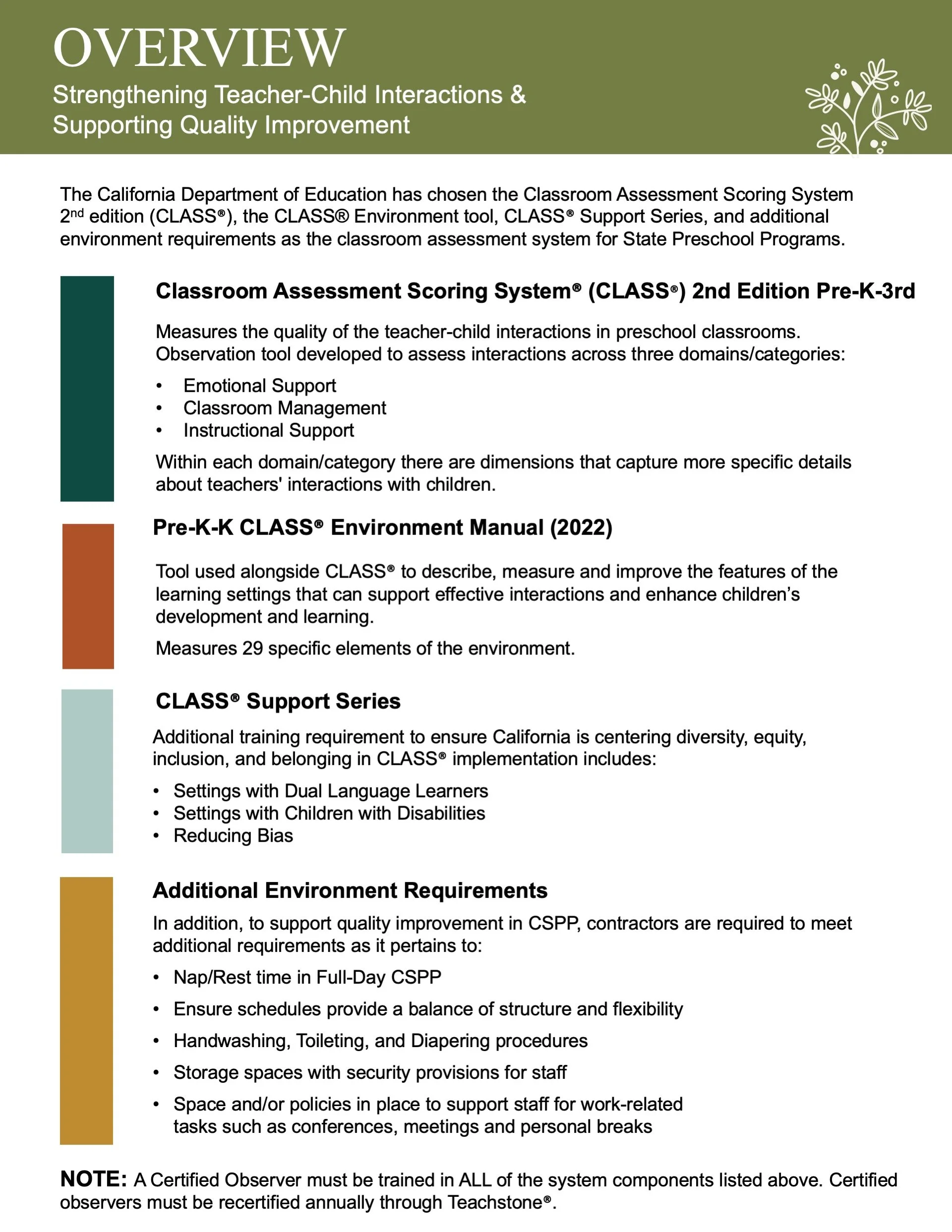
The California Department of Education has specifically chosen the Classroom Assessment Scoring System, known by its acronym CLASS®, the CLASS Environment™ tool, CLASS® Support Series, and additional environment requirements as the classroom assessment system for State Preschool Programs for the purpose of strengthening teacher-child interactions and supporting quality improvement.
The classroom assessment system is incorporated through a graduated phase-in schedule, with full implementation by program year 2028–29. During this phase in period, all contractors must have a plan in place for implementing CLASS® and CLASS Environment™.
CLASS® Implementation Plan
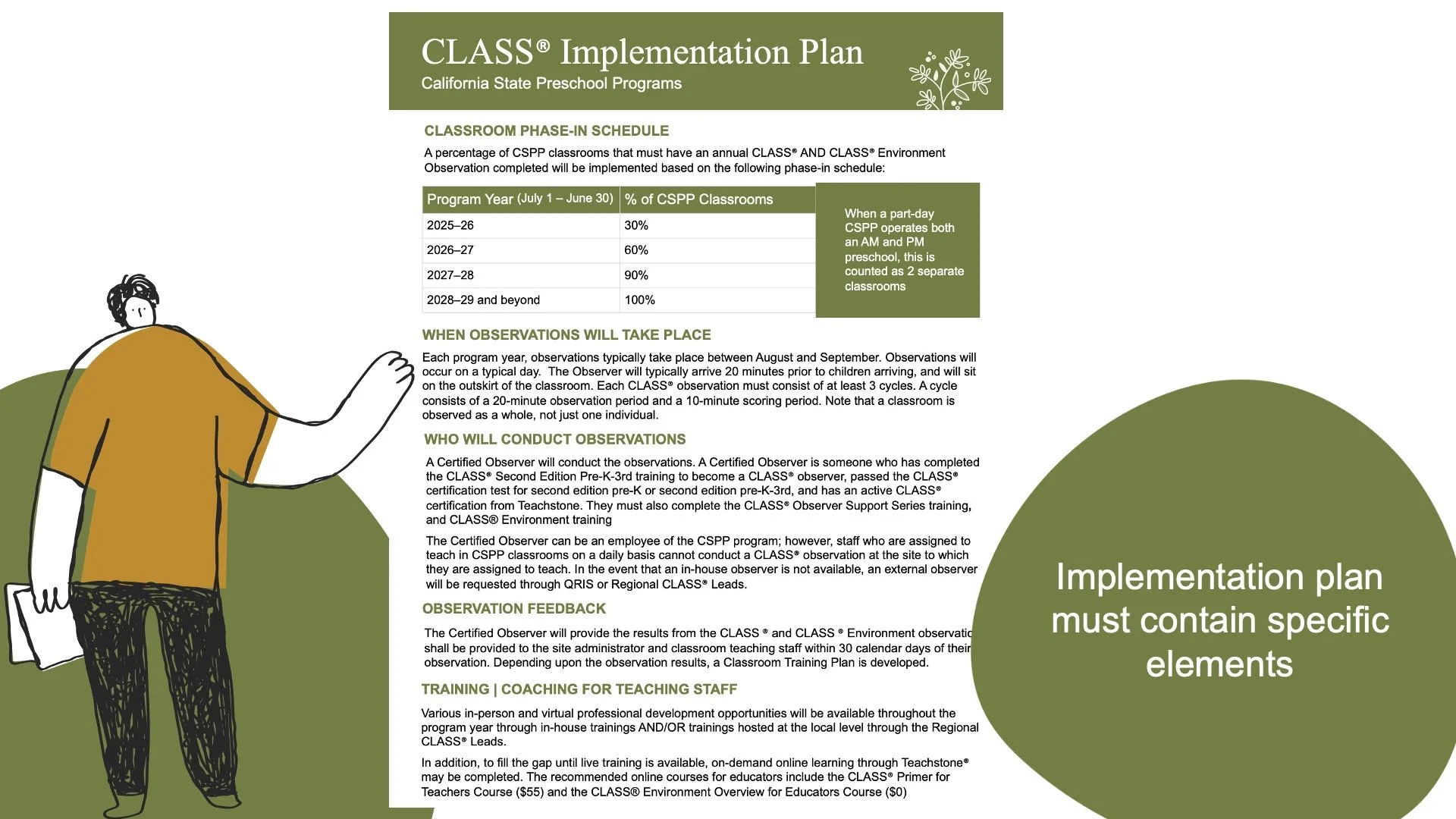
The implementation plan must include when observations will take place, how classrooms will be phased-in, who will conduct observations, what training or coaching is available to teachers/staff, and how feedback will be provided back to the teaching staff in observed classrooms as part of the program’s continuous improvement.
NOTE: Talk with your program Director or Administrator regarding the specific CLASS® implementation plan for your agency
CLASS®
What is CLASS® (2nd edition)
Teachstone®. Leading with Interactions [Video]. Embedded May 26, 2026
Through Teachstone®, a contractor may access the Classroom Assessment Scoring System (CLASS®) tool, which is an observational instrument that captures the quality of the educator-child interactions in a classroom.
For preschool age children, CLASS® assesses three DOMAINS of classroom experience:
Emotional Support
Classroom Organization
Instructional Support
Within each domain are DIMENSIONS that define the aspects of effective interactions in line with how kids learn and develop as they grow.
Each dimension has INDICATORS, which are the specific kind of behaviors that can be observed in classrooms.
NOTE: During a class assessment, the certified observer takes notes on observed interactions. The observer looks for certain behavioral markers and assigns scores for each dimension.
Observer will typically arrive 20 minutes prior to children arriving, and will sit on the outskirt of the classroom. Each CLASS® Observation must consist of at least 3 cycles. A cycle consists of a 20-minute observation period and a 10-minute scoring period.
CLASS® Certified Observer

At the heart of CLASS® are trained and certified observers. A certified CLASS® observer means someone who has completed the training to become a CLASS® observer, passed the CLASS® certification test, and has an active CLASS® certification from Teachstone®.
In addition, the observer must have completed the CLASS® Observer Support Series training and be trained on CLASS Environment™.
An observer can be an employee of the State Preschool program; however, staff who are assigned to teach in state preschool classrooms on a daily basis cannot conduct a CLASS® Observation at the site to which they are assigned to teach.
NOTE: In the event that an in-house observer is not available, an external observer will be requested through QRIS or Regional CLASS® Leads.
CLASS® Scores
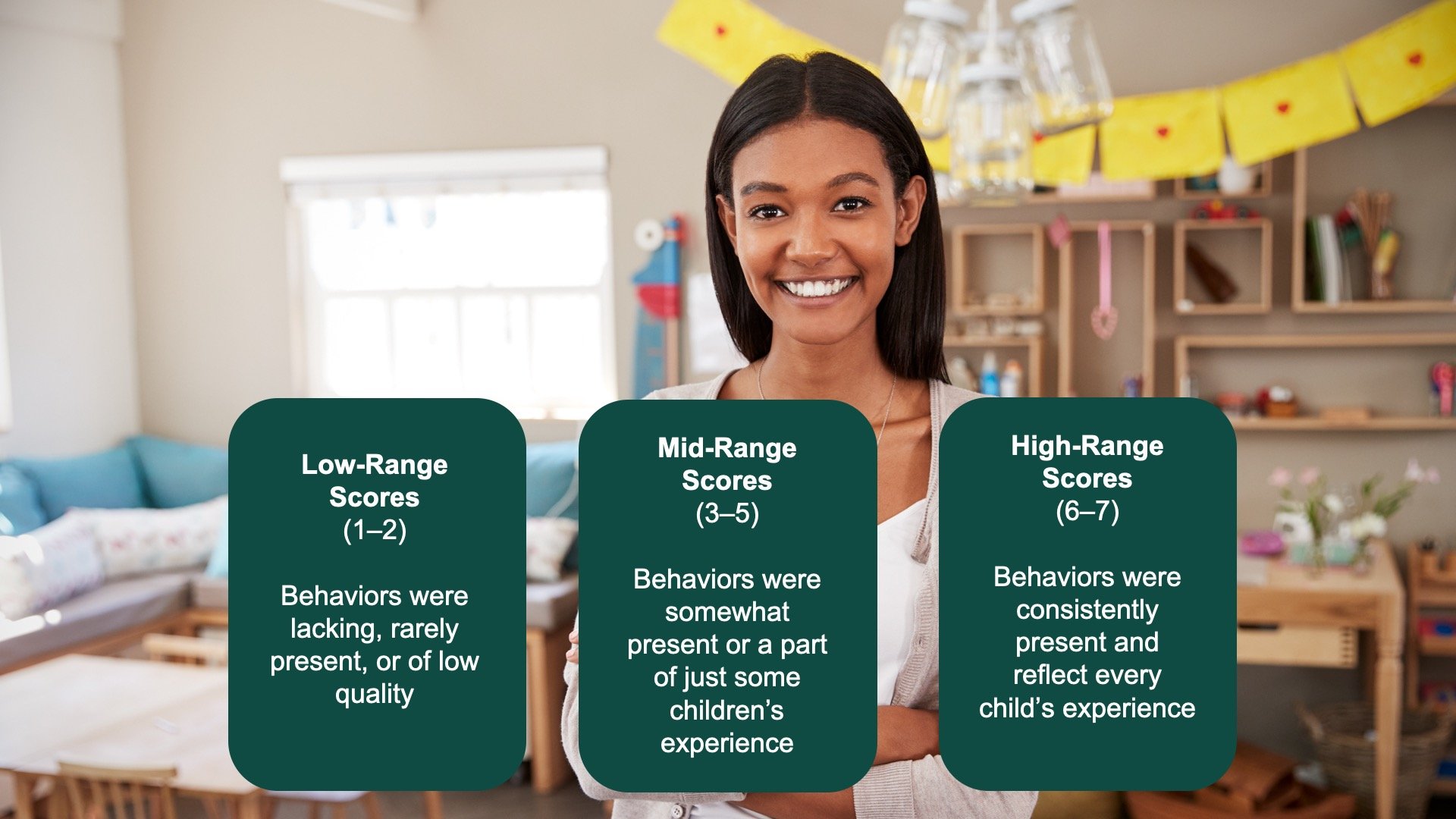
Certified CLASS® observers use the CLASS® tool to capture the quality of the educator-child interactions they see in a classroom. Note that the classroom is observed as a whole, not just one teacher. The observer looks for certain behavioral markers. They then assign scores which range from 1 to 7 across each dimension.
Low-range scores (1–2): Behaviors were lacking, rarely present, or of low quality
Mid-range scores (3–5): Behaviors were somewhat present or a part of just some children’s experience
High-range scores (6–7): Behaviors were consistently present and reflect every child’s experience
The Certified Observer will provide the results from the CLASS® within 30 calendar days of their observation. Contractors must ensure the data is reported to MyTeachstone no later than 30 calendar days after receiving the results of a CLASS® Observation.
NOTE: CLASS® data should be used by preschool programs to inform professional development, coaching, and other continuous quality improvement efforts. CLASS® scores can NOT be used to evaluate staff competency.
Getting Observed
Teachstone®. A Teacher’s Take on CLASS Observations [Video]. Embedded July 22, 2024
What to expect when a classroom is going to be assessed.
Observations typically take place between August and September
The classroom is observed as a whole, not just one individual
Observation should occur on a typical day, in order to get a good snapshot
Observer typically arrives 20 minutes prior to children arriving, and will sit on the outskirt of the classroom to observe in 20 minute increments
Typically an Observer will conduct both the CLASS® and CLASS Environment™ Observations on the same day.
Be yourself | Trust in yourself | Take a deep breathe
CLASS Environment™
What is CLASS Environment™
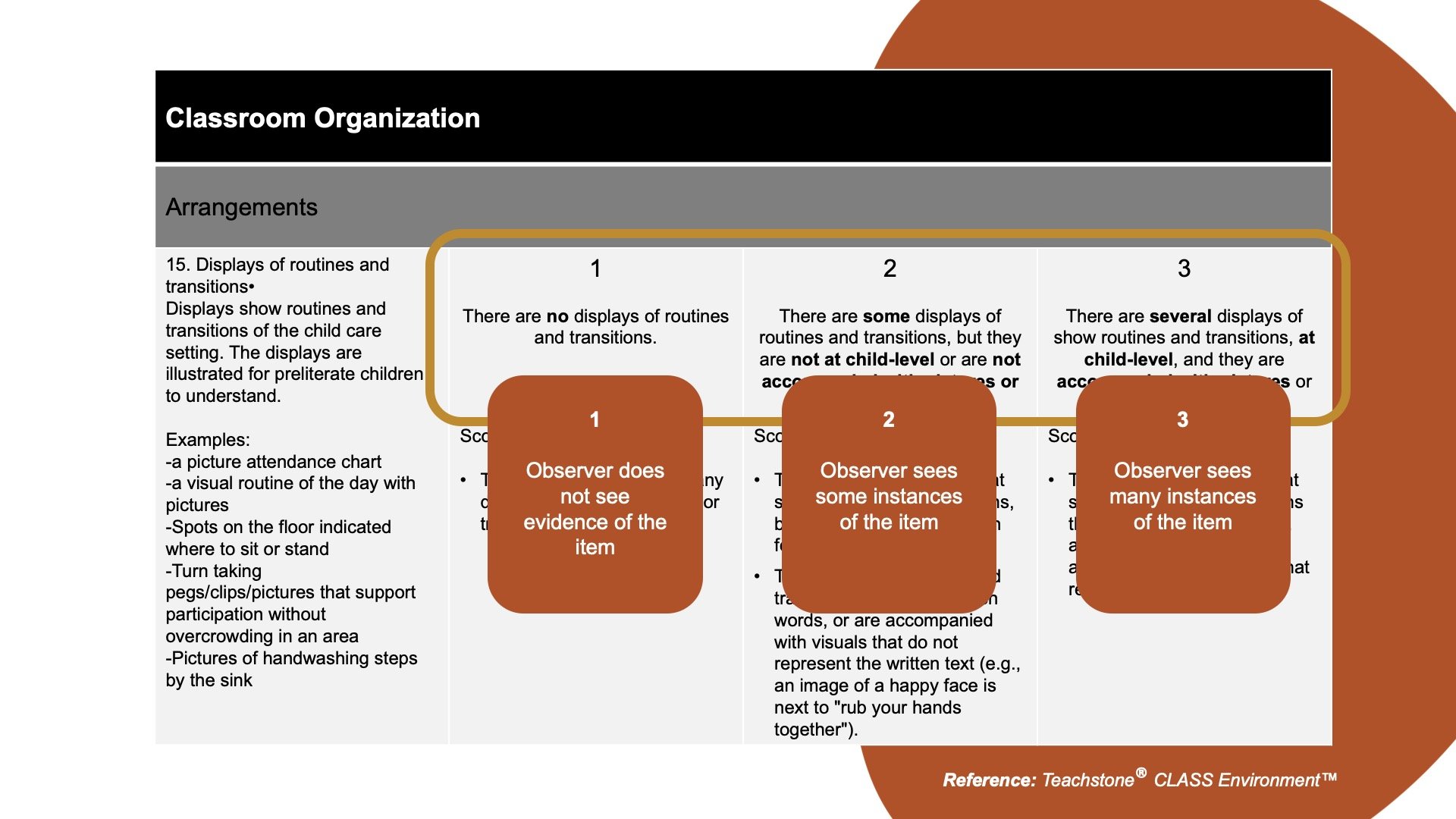
CLASS® focuses on interactions and CLASS Environment™ focuses on the elements in the learning setting that support meaningful interactions. By focusing on the features of the classroom (Arrangements | Displays | Materials) that most directly influence teaching and learning, CLASS Environment™ can support educators in designing settings to better support quality interactions.
CLASS Environment™ does not focus on the number of items, but instead focuses on whether specific items in the learning setting are present.
CLASS Environment™ is organized around the three CLASS domains: Emotional Support, Classroom Organization, and Instructional Support. It is designed to measure environmental elements using a 3-point scale that reflects the degree to which an item was present and/or used within the learning experience.
Observer does not see evidence of the item
Observer sees some instances of the item
Observer sees many instances of the item
NOTE: Observers can typically capture environmental quality data in under 15 minutes. The CLASS Environment™ observation is done in addition to the CLASS® observation’s three cycles. Typically an Observer will conduct both the CLASS® and CLASS Environment™ Observations on the same day.
CLASS® Support Series
Snapshot of CLASS® Support Series
To ensure California is centering diversity, equity, inclusion, and belonging, the Classroom Assessment System must also include supports for:
Children with Disabilities: During a CLASS® observation, an observer will capture the ways educators adapt or modify materials so that children can fully engage with them, and adapt or modify activities so that children are able to contribute in meaningful ways.
Dual Language Learners: Observer will capture interactions or strategies used by educators to create a supportive environment for dual language learners.
NOTE: As part of an observers training, they must complete the CLASS® Observation Support Series training designed to bring awareness and share strategies to reduce observers' biases during a CLASS® observation.
Additional Environment Requirements
Snapshot of Additional Quality Components
State Preschool contractors are also required to meet a few other additional environment requirements.
Provide children enrolled in Full-Day State Preschool for over 4 hours with a regularly scheduled time to nap or rest. Furthermore, with regards to napping:
Cots or mats must be at least 18” apart.
Napping and rest activities must be provided in a clean and sanitary manner.
Space must be conducive to resting.
Schedule must provide a balance of structure and flexibility. The schedule must include the following each day:
A variety of play activities
Both fine and gross motor active play
At least one indoor and one outdoor play period (weather permitting)
NOTE: Programs that operate fewer than 4 hours per day must schedule at minimum 30 minutes total of outdoor play during the program hours & programs that operate 4 or more hours per day must schedule at minimum 60 minutes total of outdoor play during the program hours. Outdoor time may be divided into shorter periods as long as the total time per day is met.
Written hand washing procedures are posted in a place that is visible to children and adults. Hand washing procedures must be followed by children and adults.
Written and visual diapering procedures that are non-punitive, developmentally, and age-appropriate must be posted that are visible & followed by all children & adults.
Provide storage spaces with security provisions where staff can store their personal belongings.
Space and/or policies in place to support staff for work-related tasks such as conferences and meetings and to support staff for personal breaks.
Complete Knowledge Check ❯
After reviewing the video lesson & sketch pad notes, it’s time to check for understanding by completing a Knowledge Check. Note that Individual Knowledge Checks will conclude with a Certificate.