

Lesson
Dashboard
Lesson 1
Family Data File
Lesson 2
Attendance
Lesson 3
Provider Payments
Lesson 4
Family Selection & Enrollment Activities
Lesson 5
Parent Involvement & Education
Lesson 6
Health & Social Services
Lesson 7
Expulsion & Suspension
Lesson 8
Community Involvement
Lesson 9
Site Licensure
Lesson 10
Adult-Child Ratios
Lesson 11
Environment Rating Scale
Lesson 12
Nutritional Needs
Lesson 13
DRDP & Education Program
Lesson 14
Parent Survey
Lesson 15
Qualified Director
Lesson 16
Staff Development/
Provider Support
Lesson 17
Refrain from Religious Instruction
Lesson 18
Inventory Records
Lesson 19
Program Self-Evaluation
Lesson 20
FCCHEN Provider Participation
Lesson 21
Contractor Parent Policies
Lesson 22
Fiscal Essentials: CFCC Contract Type
Lesson 23
Fiscal Essentials: CCTR Contract Type

Introduction to State Contracts
Before building an enrollment and projection plan, it’s important to know & understand what is on your program contract.
Upon being awarded a program contract through the Request for Applications (RFA) process , we see the contract process as on ongoing 3 part cycle that includes
Contract & Amendments
Continued & Expansion Funding Application (CEFA)
Program Changes
This lesson was designed to support programs with understanding what is on their contract, along with the contract process.
Reference
Watch Video Lesson ❯
Accessibility Note: The complete accessible content is available in the video and transcript below. The transcript can be accessed using the transcript option in the video player controls. The slide deck is provided for visual reference and may not be fully accessible.
Video Description: This video explains the ins and outs of center-based & FCCHEN contracts funded through the California Department of Social Services.
Sample Forms/Tools ❯
Review Sketch Pad Notes ❯
Request for Applications

Request for Applications also referred to as RFA is released as funds become available.
Department issues notification to contractors via a Child Care Bulletin. Interested applicants can apply electronically using the online portal that will be made accessible through a link on the Child Care Bulletin.
Applicants that are awarded a CDSS contract are required to adhere to all applicable laws & regulations associated with the contract as well as the terms & conditions set forth in the Funding Terms & Conditions (FT&Cs) & Program Requirements applicable to the fiscal year in which the services are provided.
NOTE: Being awarded does not immediately mean that a contractor is given a contract. There is communication that happens between the fiscal analyst & the new contractor before the contract is created – at a minimum, site licenses and verified start dates are needed. Potentially, the award amount is prorated for the first year of operation.
Contracts/Amendments
Once awarded, a contract for new applicants or a contract amendment for existing applicants is issued.
Contract Information
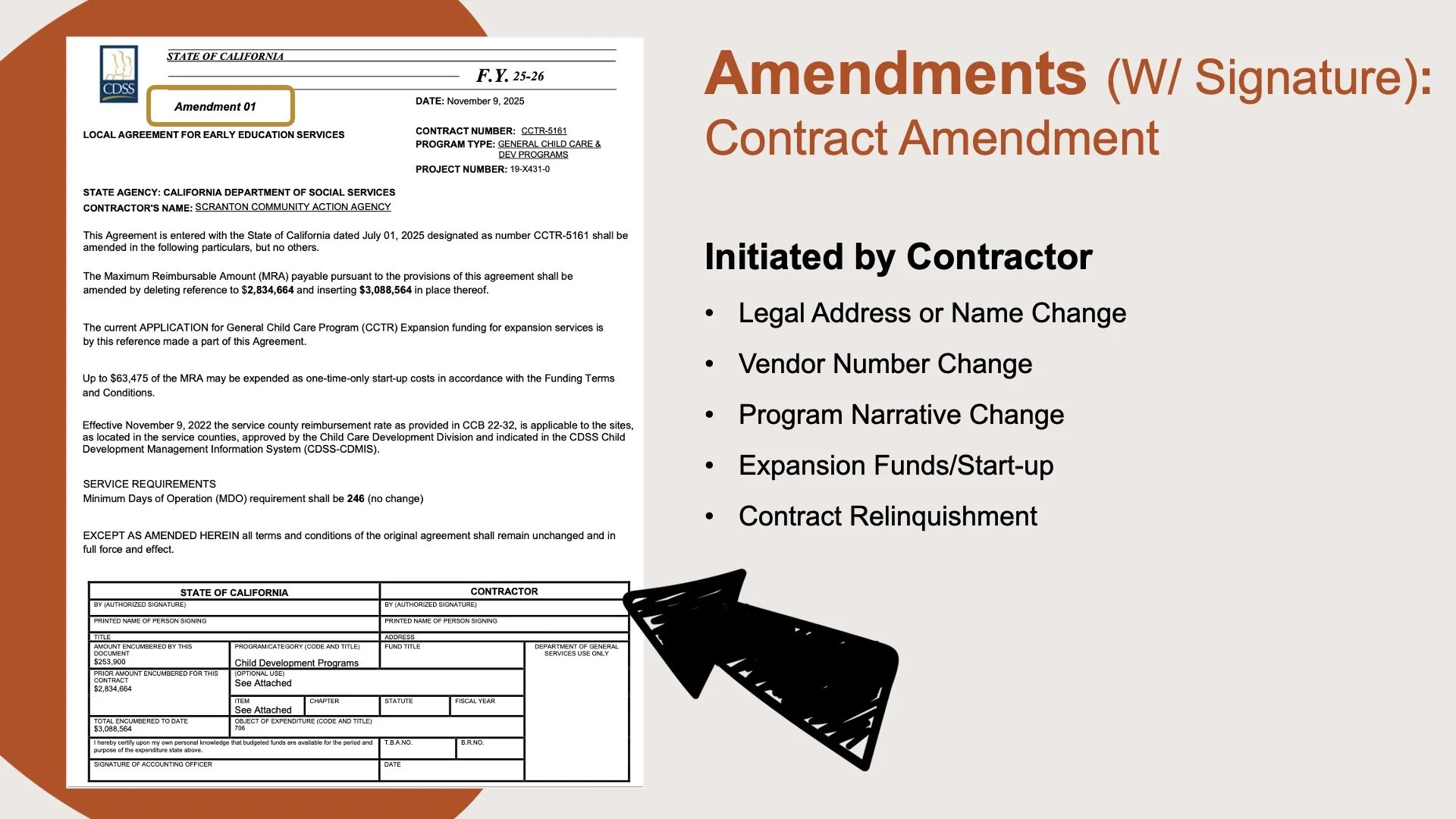
The contract is a legally binding agreement between a child care contractor & the Department in which the contractor agrees to provide child development services according to defined programmatic & fiscal requirements.
Contracts are sent to the e-mail addresses for both the Executive Director & Program Director on file.
NEW Contractors must sign and return their initial contract
Contractors who apply & are approved for continued funding through CEFA process will not need to sign and return initial program year contract
Once the contract is executed by the Contracts Office, it becomes eligible for payment. No apportionments can be made until a contract is deemed executed by the Contracts Office
Contractor will receive a copy of the fully executed contract
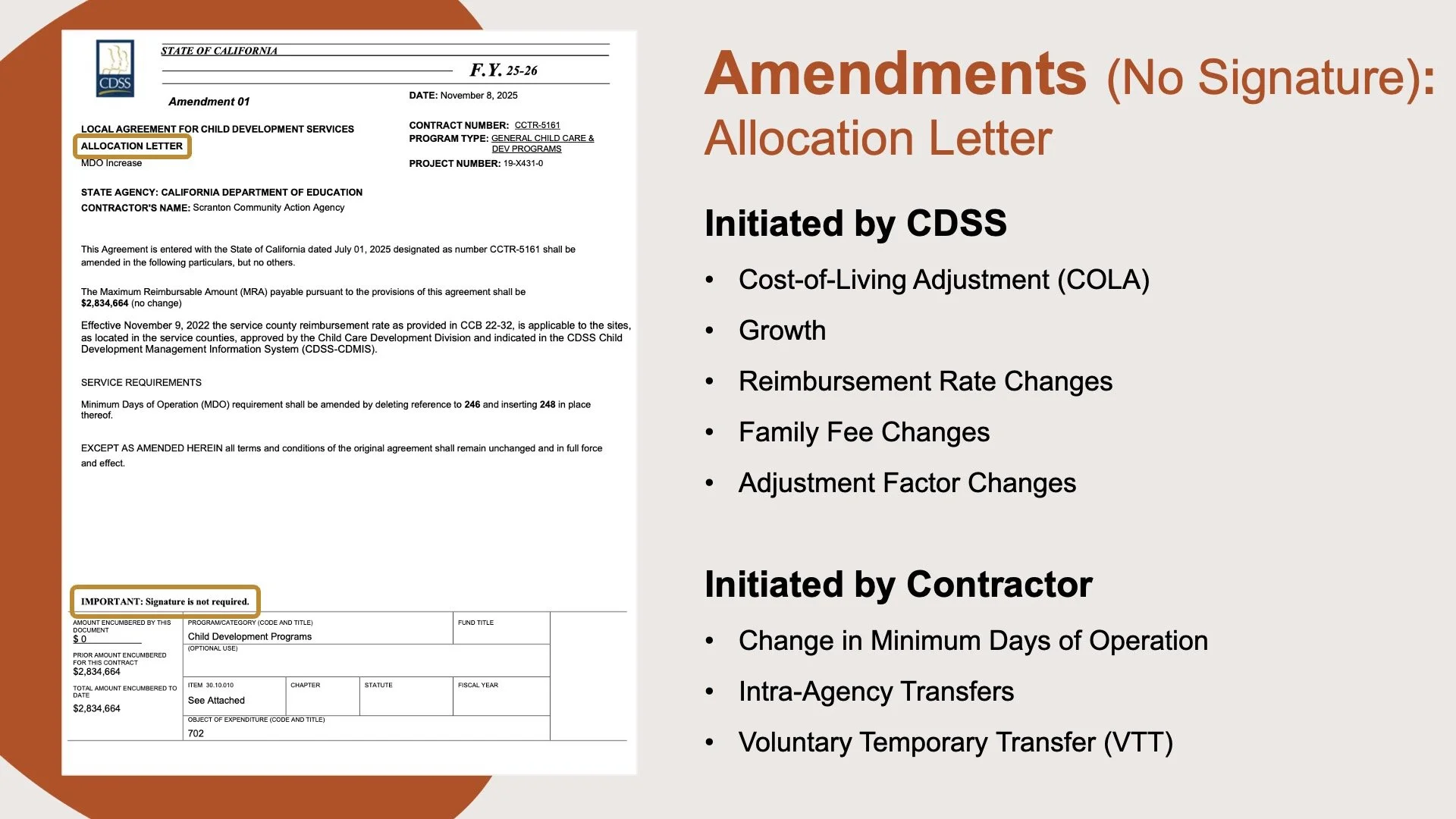
Not all amendments will require a signature. Contract amendments that do not require a signature will be processed as an Allocation Letter which will look similar to a contract amendment, & will include the contract face sheet & any changes in funding, where applicable.
Program Type
Some agencies operate one program type, while others operate many. A separate contract is issued for each program type.
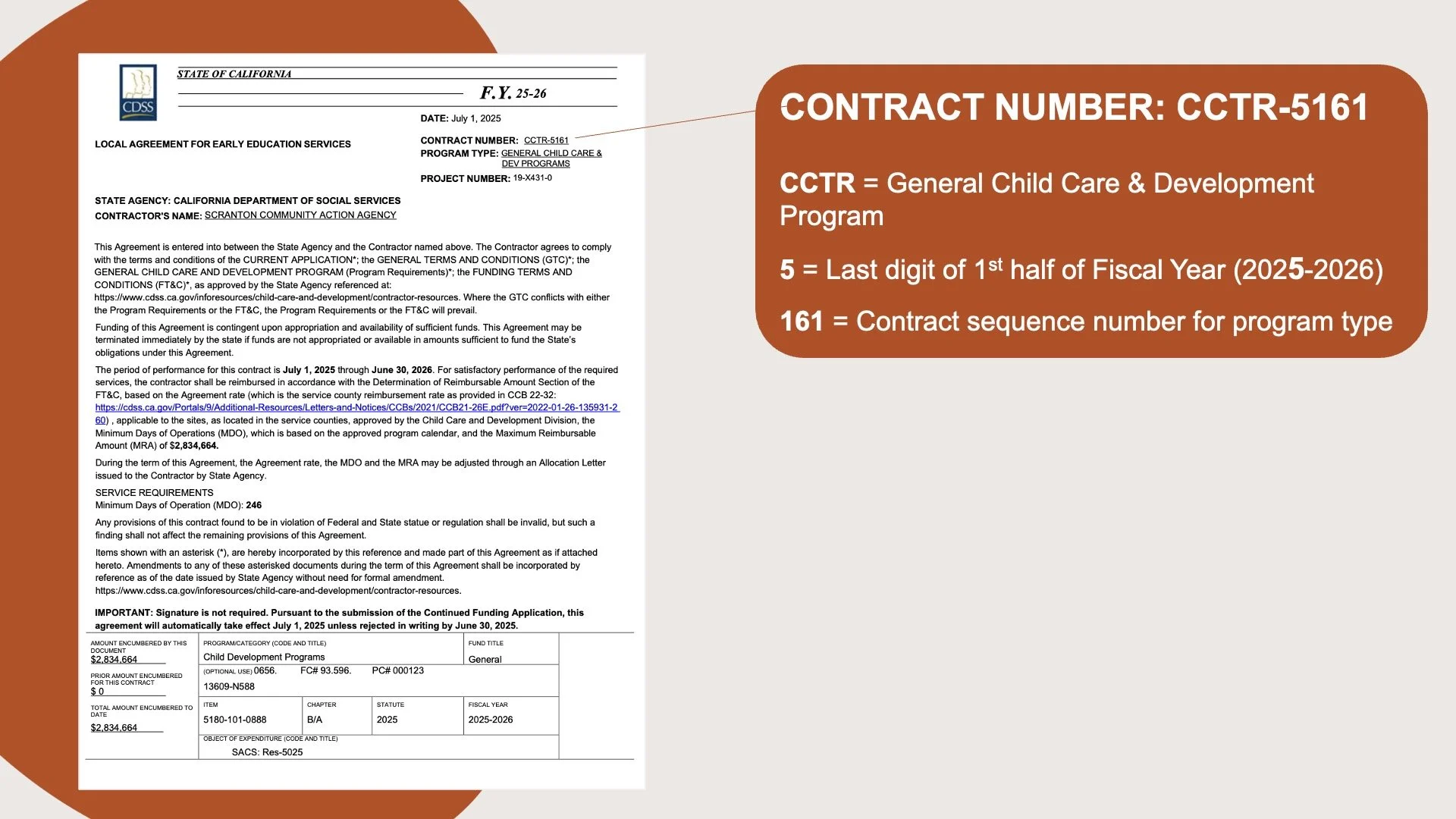
Contracts are not renewed annually; instead, agencies apply for continued funding & a new contract is issued each fiscal year with a different contract number.
The first four characters designate the program type. The first number designates the fiscal year, which is the last digit of the first half of the fiscal year. The last three numbers are the contract sequence number within that program type.
Maximum Reimbursable Amount
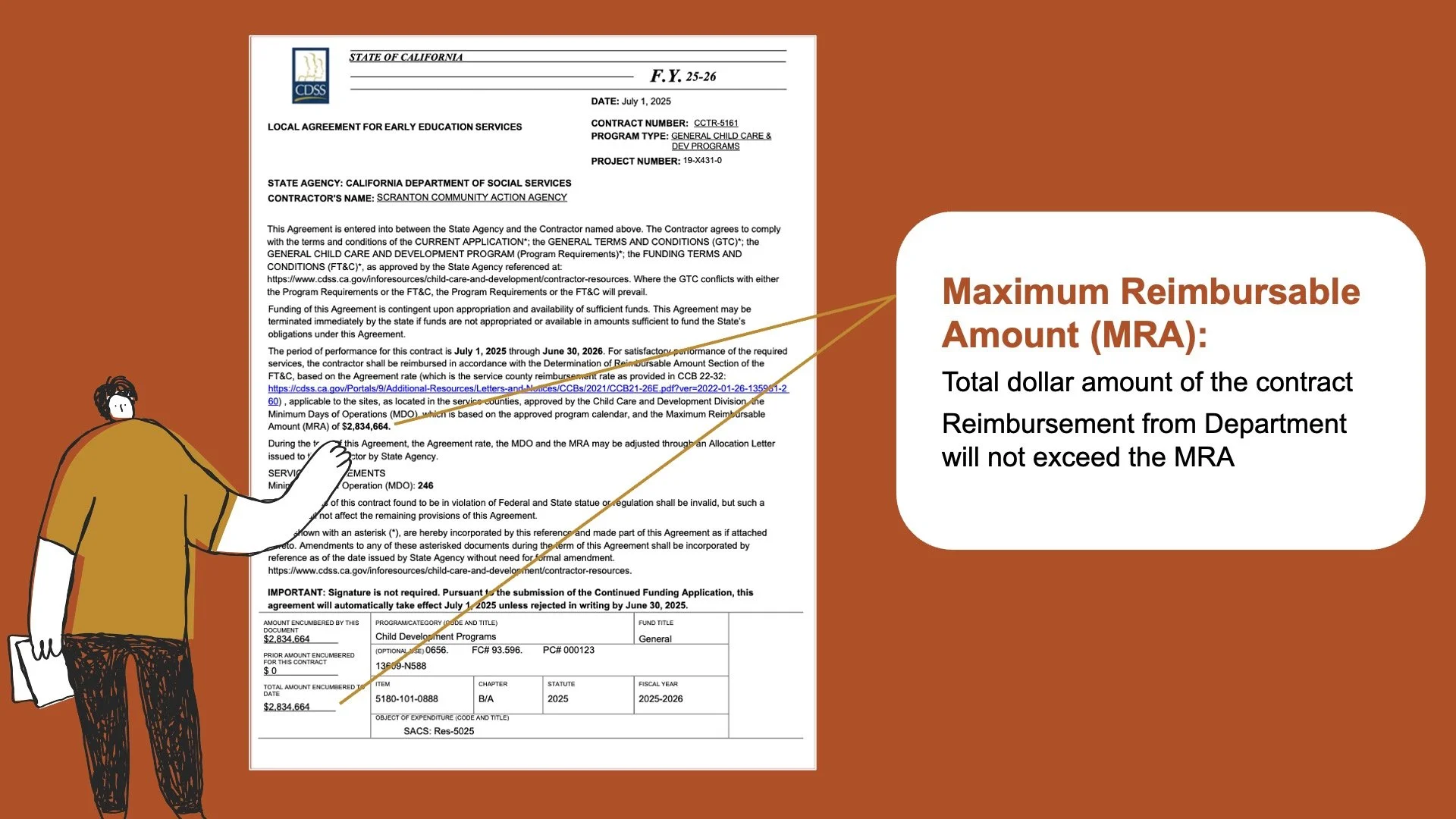
The Maximum Reimbursable Amount, also known as MRA, means the total dollar amount of a contract. This is the most that an agency will be paid for their child services or reimbursable expenses in a given fiscal year.
NOTE: Changes to the MRA during the fiscal year will require an amendment to the contract.
The MRA is located within the narrative & within the table. In the event the the contract is amended, it will show both the prior encumbrance, amended encumbrance & new maximum reimbursable amount.
Contract Rate (Per-Child Reimbursement)
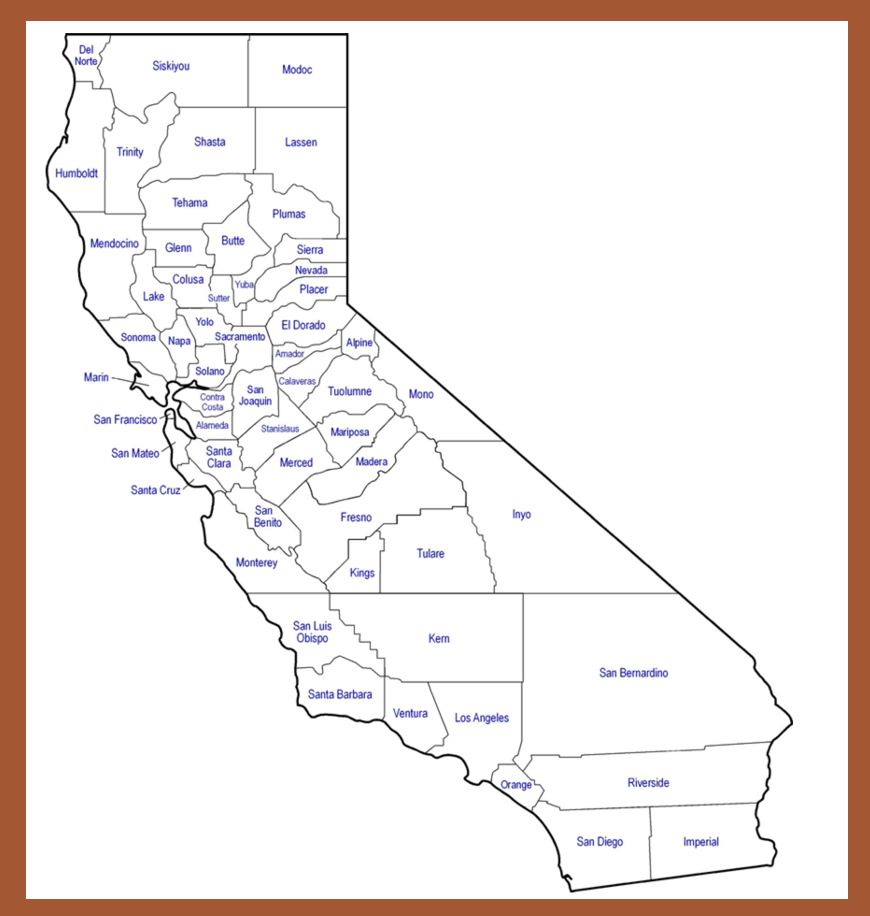
The Contract Rate is the service county per child per day reimbursement rate based on full-time equivalency, known as FTE, for a child who is 3 years or older.
NOTE: County Contract Rates are located within Child Care Bulletin 22-32. The data within the table at the end of the bulletin shows reimbursement rates by service county effective July 1, 2022.
If contractors operate within multiple service counties, contractors may have multiple contract rates as rates will be specific to the county in which services are provided to certified children.
Child Days of Enrollment

A day of enrollment is a day that a child is certified to attend a program per the contractor’s Notice of Action. A day of enrollment will always fall on a day that the agency is open and providing services.
Certified days of enrollment for all children must be reported in the category of each child’s certification (Age, Time, Exceptional Needs, Dual Language Learner, etc…..)
NOTE: Child days of enrollment determine how many children must be enrolled to earn a contract in a typical year.
Time-Base Categories

Time-base categories are as follows:
A child enrolled for 25 hours or more per week is considered full-time
A child enrolled for less than 25 hours per week is considered part-time
Once the rate category is determined, the child’s enrollment for all 5 days of the week will be reported the same as either part-time or full-time one each day of the week.
If a child is certified for full-time service & for any individual day is enrolled for more than 10.5 hours, the child must be reported as full-time plus on that day.
What this might look like in a program:
Full-Time Category
Phillip is a 4-years-old certified 42.5 hours per week, 8.5 hours per day, placing him in the full-time category.
Based on the contract rate, the program would earn $54.93 for every day Phillip is certified to receive services.
Full-Time Category w/Full-Time Plus
Toby is a 3-years-old certified 56 hours per week, 8 hours per day Monday through Wednesday & 12 hours Thursday & Friday, placing him in the full-time category.
Based on the contract rate, the preschool program would earn $54.93 for every day Phillip is certified to receive services.
Thursdays & Fridays, the program will earn $64.82 since Toby is enrolled for more than 10.5 hours per day on those days.
Part-Time Category
Cece is a 2-years-old certified for 24 hours per week, 6 hours per day Monday & Tuesday & 4 hours a day Wednesday through Friday, placing her in a part-time category.
Based on the contract rate, the program would earn $54.38 for every day Cece is certified to receive services.
Adjustment Factors

In a typical year, since service-level earnings are based on the contract rate multiplied by Adjusted Days of Enrollment, this practice results in different reimbursement levels.
NOTE: Contract rates & adjustment factors may vary from county to county, & program to program.
Even though enrollment levels will not count towards earning your contract this fiscal year, an agency needs to still report based on the Adjusted Days of Enrollment, per Title 5 regulations
Beyond time based categories, there are various other reasons an adjustment can be made to the contract rate, such a child’s age, if they have exceptional needs, dual language learner, at-risk, severely disabled or mental health consultative services within CCTR programs.
Contractors who elect to implement Mental Health Consultation Services to support teaching staff & families by helping to address challenging behaviors in the classroom or family child care home setting, may claim an adjustment factor of 1.1.
This increased adjustment factor applies to all children enrolled in the classroom or family child care home setting where services are provided; therefore children would be reported in the MHCS certified enrollment section of CDPR, & not in the non-MHCS certified section.
What this might look like in a program:
Ryan, a 4 year old child, is certified for 24.5 hours per week placing him in the part-time category.
Ryan has a current IEP on file; therefore the contract reimbursement rate of $54.93 would be adjusted by multiplying the rate by .847 to reflect the part-time day reimbursement.
The program would earn $46.53 for every day Ryan is certified to receive services.
Minimum Days of Operation
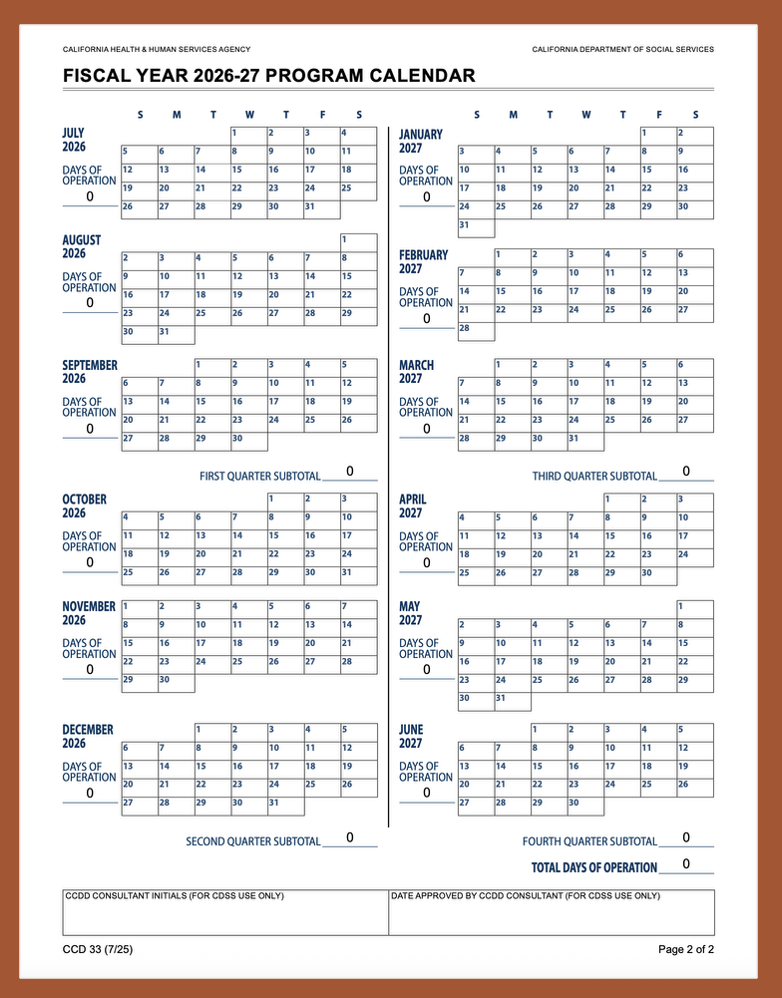
A “Day of Operation” is a day the contractor provides child care & development services for one or more certified children enrolled. The minimum days of operation are determined by the service calendar submitted annually for each program.
NOTE: If your MDO needs changed, submit a revised Program Calendar, along with a Program Calendar Change form.
Continued Funding Application
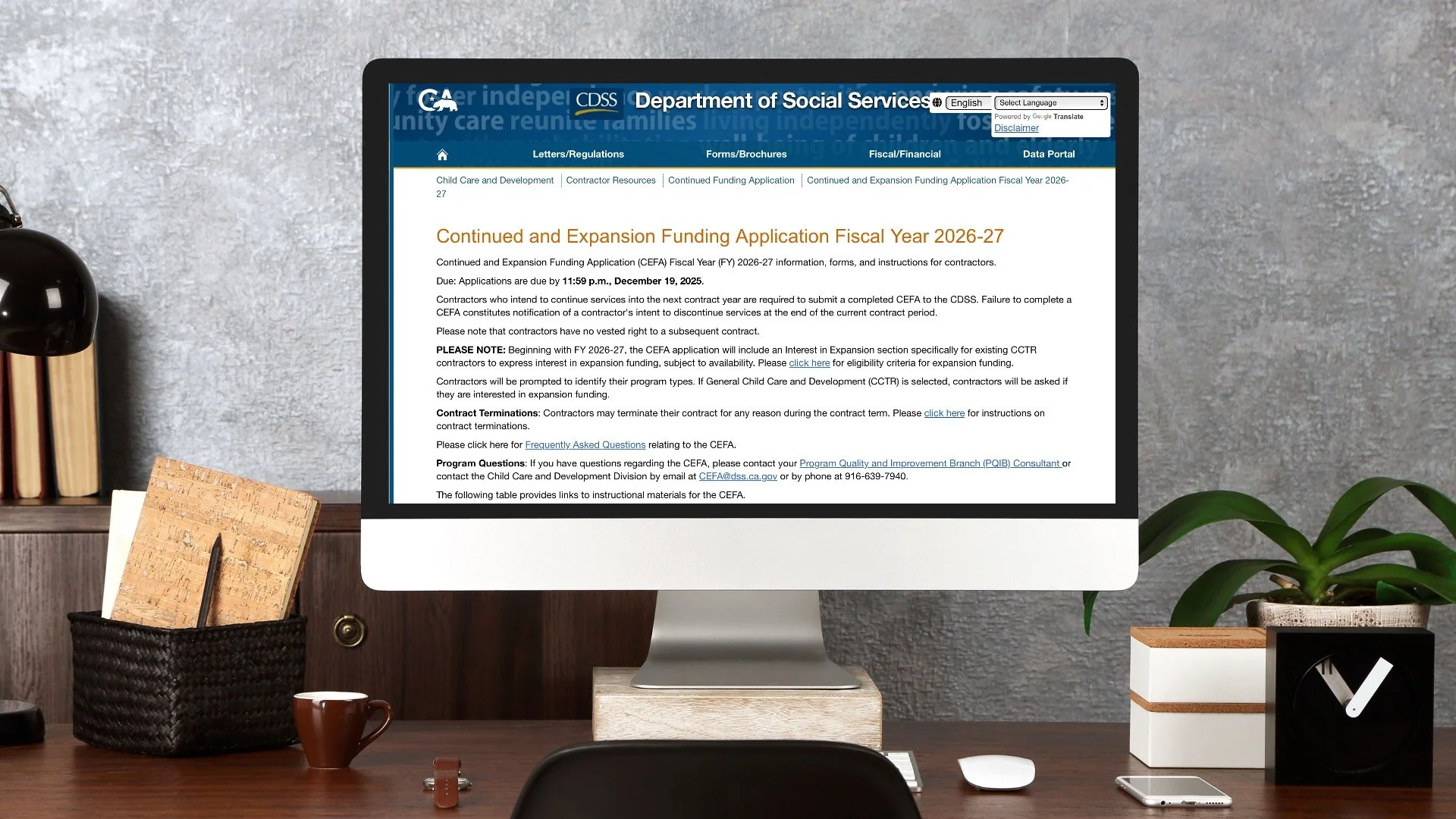
After the initial contract period, the contractor’s eligibility for continued and expansion funding each subsequent year is contingent upon compliance with all department & statutory requirements along with the completion & submission of a Continued & Expansion Funding Application (CEFA).
Each year around November, the Department issues a Child Care Bulletin notifying contractors of the release of the Continued & Expansion Funding Application for contractors who intend to continue services into the next contract year.
Contractors who apply for & are approved for continued funding through the CEFA process will be automatically renewed.
NOTE: Failure to respond within the timelines specified in the CEFA request shall constitute notification to the Department of the contractor’s intent to discontinue services at the end of the current contract period.
Program Change(s)
As part of the Continued Funding Application & as contract changes arise, contractors must submit a Program Narrative Change (PNC) or Program Calendar Change form along with support documentation to the Department for approval.
Calendar (MDO) Change
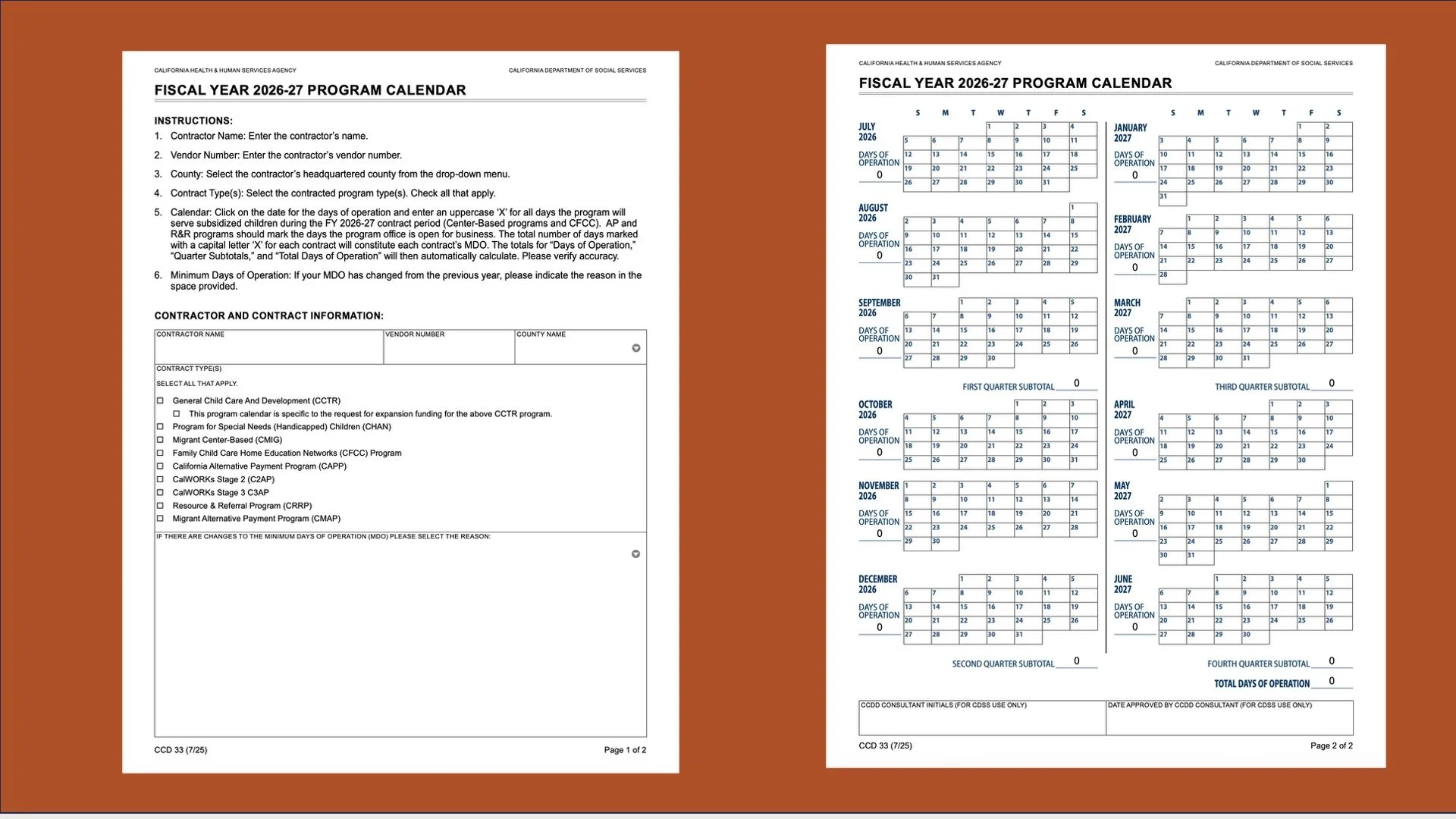
Calendar Minimum Days of Operation (MDO) changes include an increase or decrease to the MDO.
A revised calendar along with supporting documentation to substantiate the requested change must be submitted along with the Program Calendar Change Form & must be completed within the fiscal year preferably by May 1st.
Be cautious with calendar changes as this may impact your monthly funds.
On year-end calculations, if the actual days of operation are greater than or equal to 98% of the Minimum Days of Operation, the Maximum Reimbursable Amount will not be affected.
If actual days of operation are less than 98% of the Minimum Days of Operation, the Maximum Reimbursable Amount will be reduced in proportion to the percentage of contract minimum days of operation that the contractor was not in operation. This could result in a billing if the contractor has been paid more than the reduced Maximum Reimbursable Amount.
If there are date changes to your program calendar but the MDO will remain the same, contractors are not required to submit a PNC however, contractors must email their assigned PQI consultant & include a copy of the revised calendar.
Programmatic Change
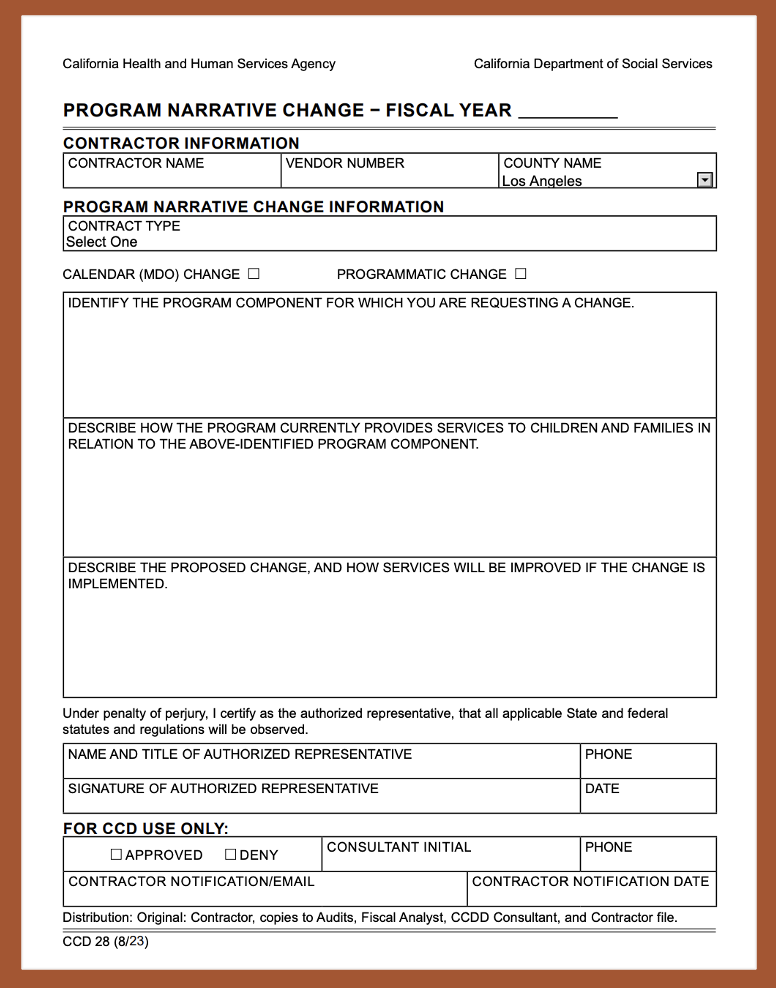
Programmatic changes include but are not limited to the opening of a new site or closing of an existing site, changes to the service area, or changes to a program model such as changing from operating General Child Care in a center to operating through a family child care home education network model.
The contractor must submit the PNC form along with any support documentation to support the request such as a parent survey or needs assessment.
PNCs submitted at the time of the Continued Funding Application for the upcoming fiscal year will receive an email notification of the approval or denial of their CEFA & requested change.
CCTR/CSPP Intra-Agency Transfers
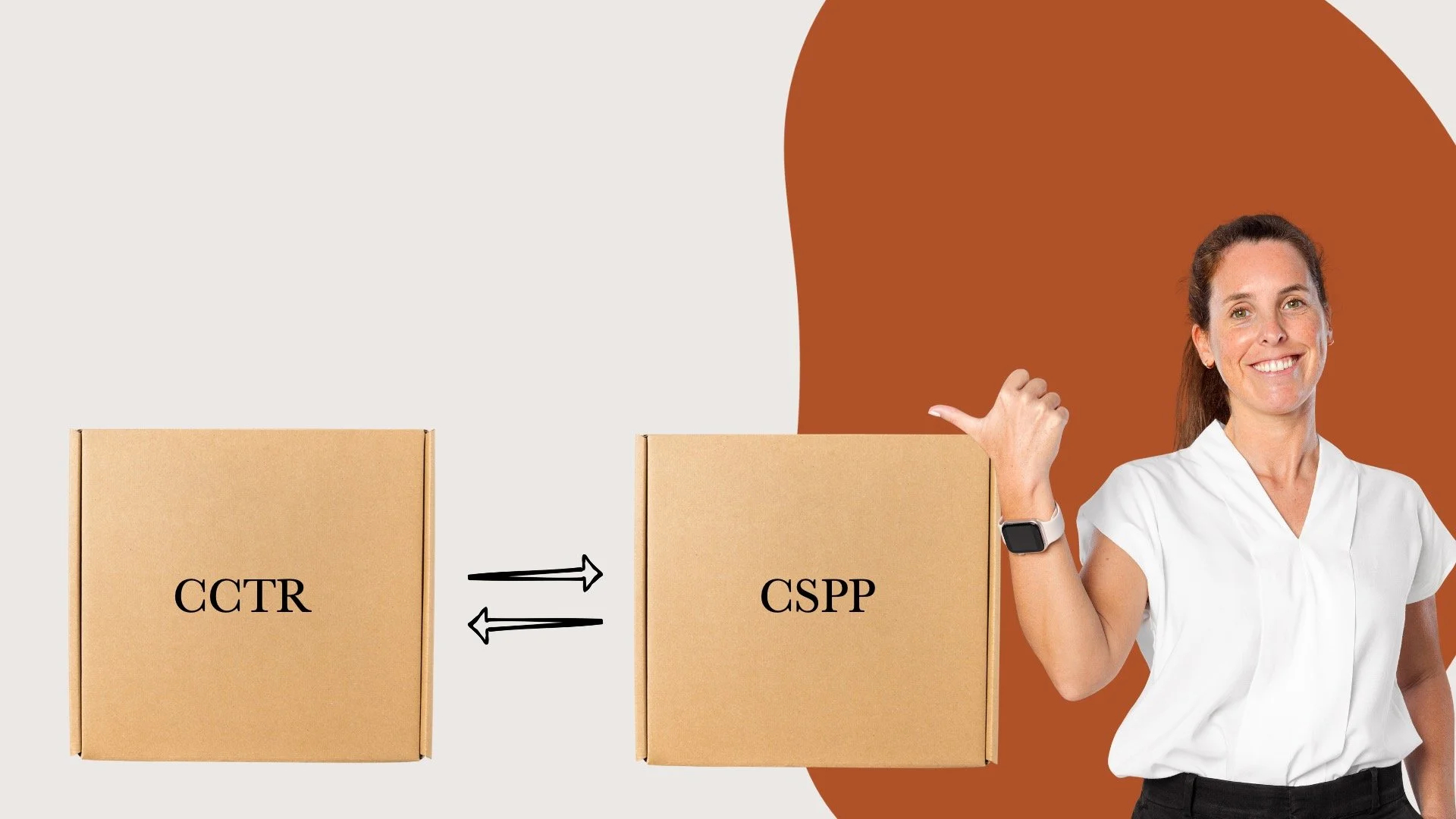
Contractors may experience changes in projected services or needs during the year. When this happens, eligible non-Local Educational Agencies (non-LEAs) that hold both CSPP and CCTR contracts may request an intra-agency transfer between the two contracts. Transfers are limited to the current fiscal year and must be requested during one of the two official transfer windows—January or April of the same contract year.
While CSPP is administered by the California Department of Education (CDE) and CCTR is administered by the California Department of Social Services (CDSS), transfers between the two programs are permitted for qualifying contractors. Regulations require CDE to attempt to arrange intra-agency adjustments between CSPP and CCTR contracts held by the same agency, with the overall goal of ensuring that child care funds are fully utilized.
Contractors submit the transfer request form through CPARIS. For the CCTR portion of the request, contractors must contact their assigned CDSS fiscal analyst by email for instructions because CDSS no longer has access to CPARIS. CDE and CDSS review the request to ensure the proposed transfer aligns with projected service earnings and reimbursable costs. If approved, the contractor will receive an allocation letter reflecting the contract amendment; no signature is required.
Note: If a significant portion of program funds is transferred, the applicable department may request a Program Narrative Change form to document the impact on the program.
What this might look like in practice:
Scranton Community Action Agency projects that it will not fully utilize its CSPP funds but needs additional funding for its CCTR contract, or vice versa. Therefore, the agency may request an intra-agency transfer.
Voluntary Temporary Transfer (VTT)

Another funding opportunity is the Voluntary Temporary Transfer (VTT), a one-time process that allows funds to be temporarily transferred from contractors who are under-earning to contractors who are over-earning within similar contract types, such as from one CCTR contract to another. This helps ensure funds are fully utilized and directed to programs with an immediate service need rather than remaining unused.
The VTT is a collaborative process involving CDSS contractors, Local Planning Councils (LPCs), department consultants, fiscal analysts, and LPC liaisons. Contractors first identify whether they are under- or over-earning and then submit a signed letter indicating their willingness to release or accept funds. These letters are typically coordinated through the LPC designee or subcommittee, but contractors may also submit them directly to their assigned fiscal analyst.
As with intra-agency transfers, timing is critical. VTT requests are accepted only during the following windows of the contract year:
November 1–15
April 15–30
After submission, the fiscal team reviews all documentation for completeness and accuracy. The Department makes the final decision to approve or deny each request and notifies all parties of the outcome. If approved, the contractor receives a contract amendment through an allocation letter, which does not need to be signed or returned.
NOTE: Transferred funds cannot be placed into a Reserve Account. If an audit later determines that VTT funds were placed into a Reserve Account, the contract’s Maximum Reimbursable Amount (MRA) will be reduced, and the contractor will be invoiced for that amount.
Complete Knowledge Check ❯
After reviewing the video lesson & sketch pad notes, it’s time to check for understanding by completing a Knowledge Check. Note that Individual Knowledge Checks will conclude with a Certificate.
