
Lesson
Dashboard
Lesson 1
Family Data File
Lesson 2
Attendance
Lesson 3
Provider Payments
Lesson 4
Family Selection & Enrollment Activities
Lesson 5
Parent Involvement & Education
Lesson 6
Health & Social Services
Lesson 7
Expulsion & Suspension
Lesson 8
Community Involvement
Lesson 9
Site Licensure
Lesson 10
Adult-Child Ratios
Lesson 11
Environment Rating Scale
Lesson 12
Nutritional Needs
Lesson 13
DRDP & Education Program
Lesson 14
Parent Survey
Lesson 15
Qualified Director
Lesson 16
Staff Development/
Provider Support
Lesson 17
Refrain from Religious Instruction
Lesson 18
Inventory Records

Compliance Indicator
The local agency maintains an inventory record for all equipment and all non-disposable items with an estimated useful life of more than one year, purchased in whole or in part with child care and development contract funds, shall be maintained.
The contractor has adopted procedure for managing equipment, purchased in whole or in part with child care and development contract funds, until disposition of the item. In addition to the requirements above, the contractor has:
A control system to ensure adequate safeguards to prevent loss, damage, or theft of the property & to investigate any loss, damage, or theft
Adequate maintenance procedures to keep the property in good condition
Proper sales procedures to ensure the highest possible return in the event the contractor is authorized or required to sell the item
Regulations/Reference
CCD Program Instrument: IV. Administrative CCD 17
Education Code: 35168
Title 5: 3946,18025, & 18067
45 Code of Federal Regulations: 75.320[d][3], [4] & [5]
2 Code of Federal Regulations: 200.313[d][1-3], [4-5], & 200.319(c)
Monitoring Review Evidence
Inventory Record containing:
e) Cost
f) Location, use & condition
g) Any ultimate disposition date including date of disposal & sale price, if applicable
a) Description
b) Serial number
c) Source of funding
d) Acquisition date
Written policies & procedures for competitive procurement including support documentation such as invoices, purchase orders & records of materials received
Inventory tagging of larger equipment items
Review of EPARS & subcontract approvals (including approvals from the previous five fiscal years)
Observation of facility equipment & expenditures
Watch Video Lesson ❯
Sample Forms/Tools ❯
Review Sketch Pad Notes ❯
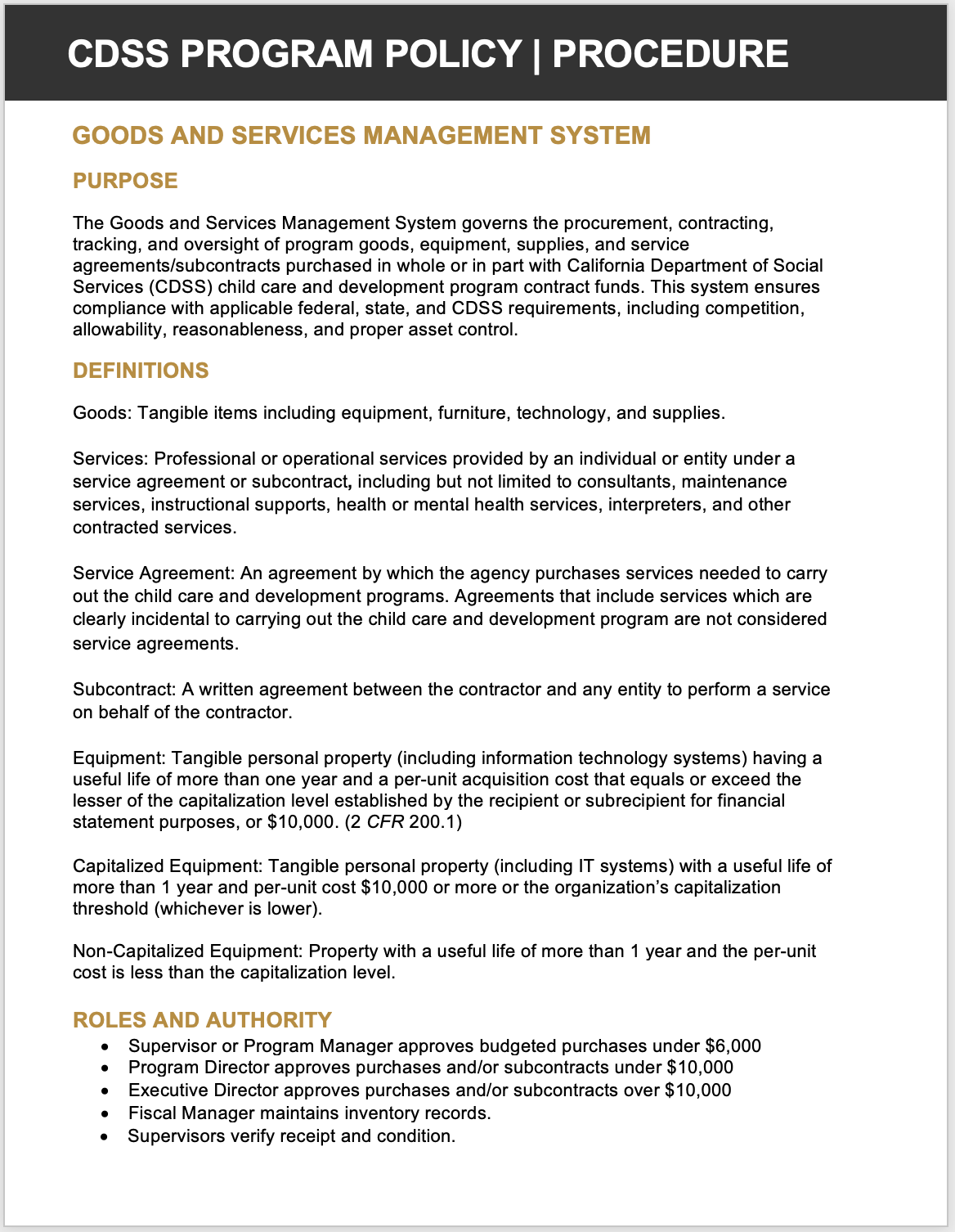
Goods & Services Management System
Below is a snapshot of a SAMPLE Goods & Services Management System that is broken down into 4 categories: Procurement of Goods & Services, Inventory Management for goods, Monitoring & Maintenance, and the Disposal, Loss & Theft of goods.
Procurement of Goods
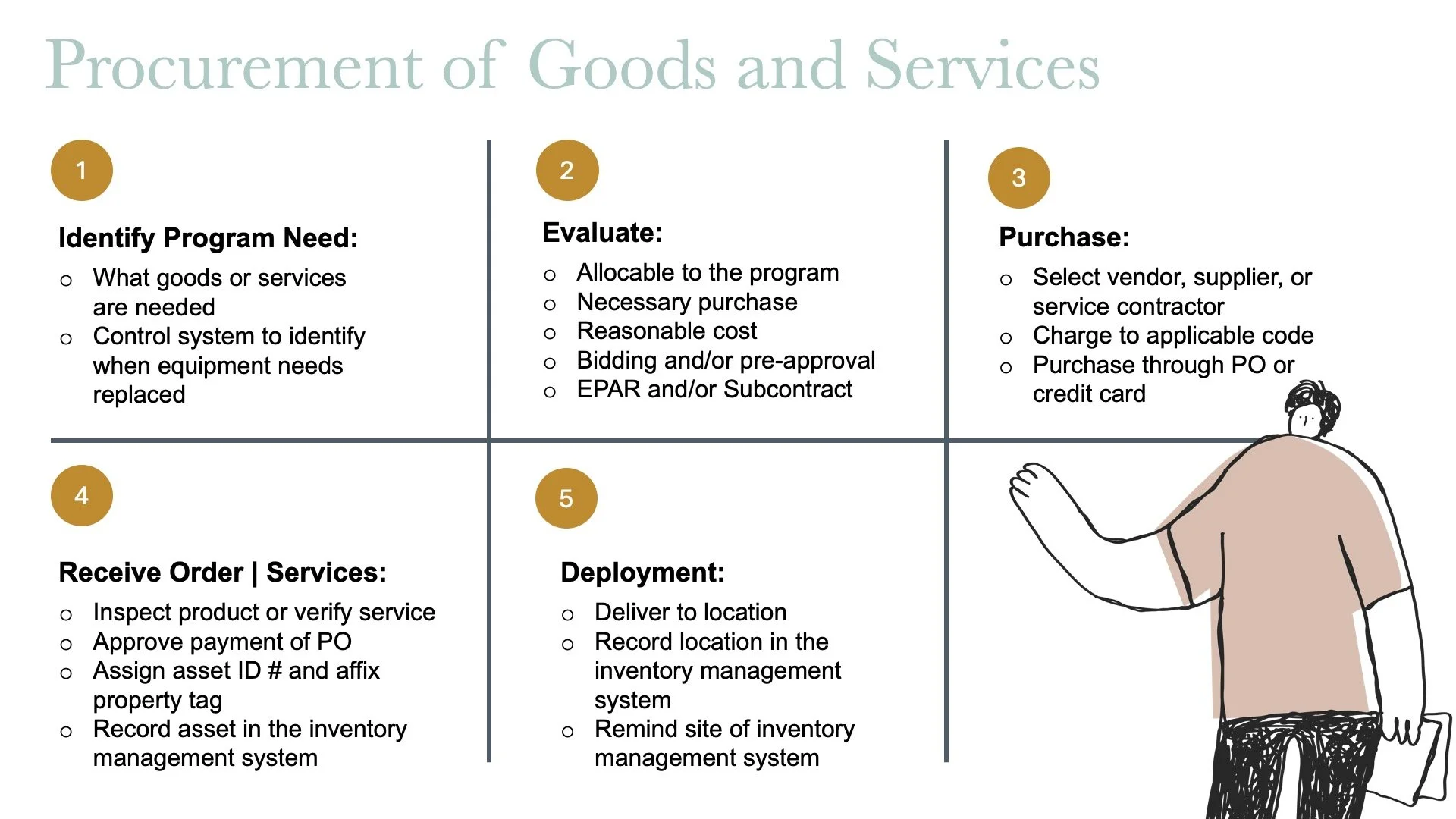
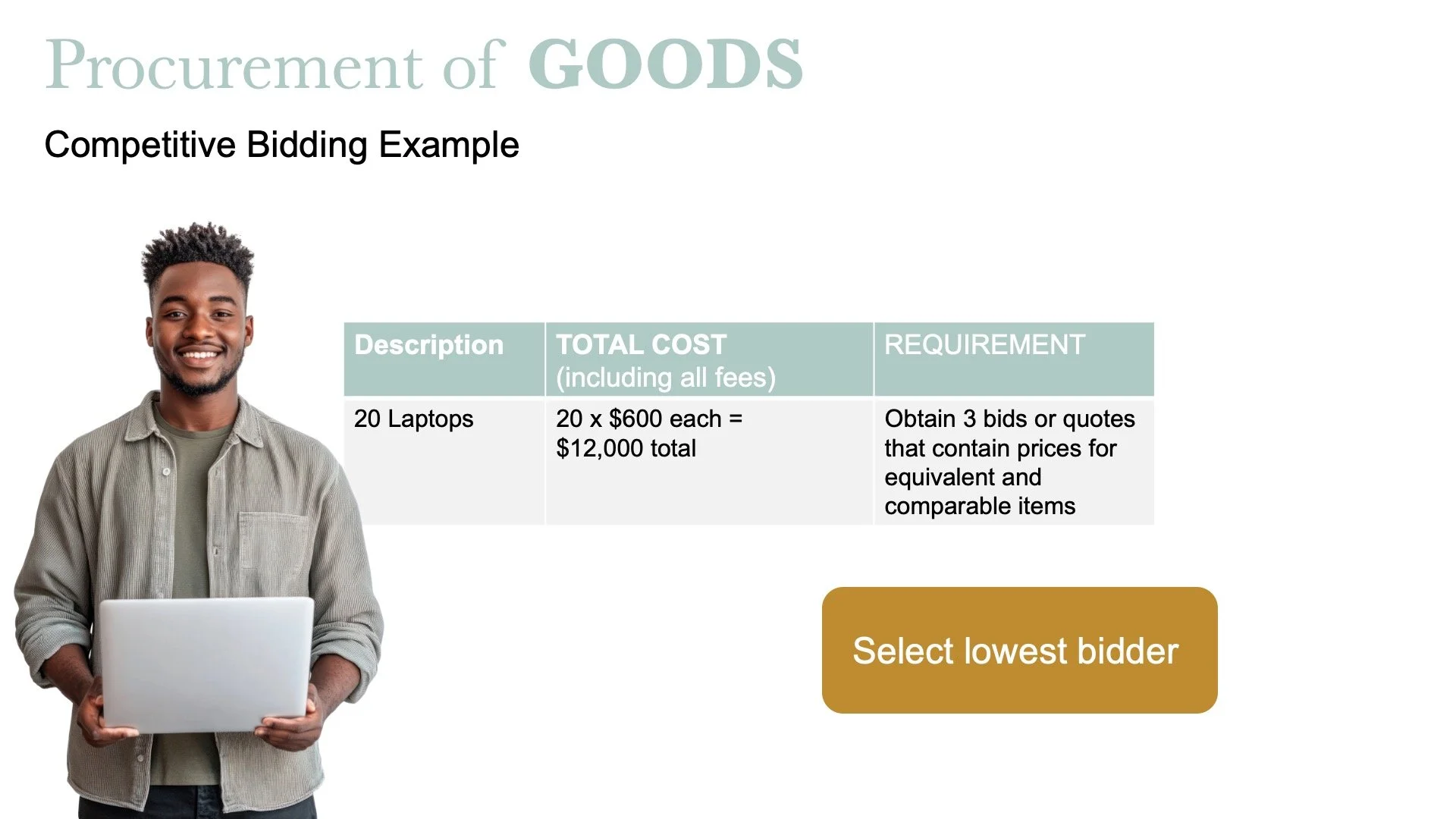
Contractors are required to have adopted procedures regarding the procurement of goods & services that prohibit conflicts of interest & ensure competition in place.
What might a procurement of goods process look like:
Identify Program Need
Beyond ongoing purchase requests & maintenance work orders, organizations should have a control system in place that identifies when large purchase items will depreciate & need replaced. This could be anything from computers to replacing a roof on a building.
Evaluate
The purchase needs must be evaluated to determine if it’s an allowable reimbursable expense.
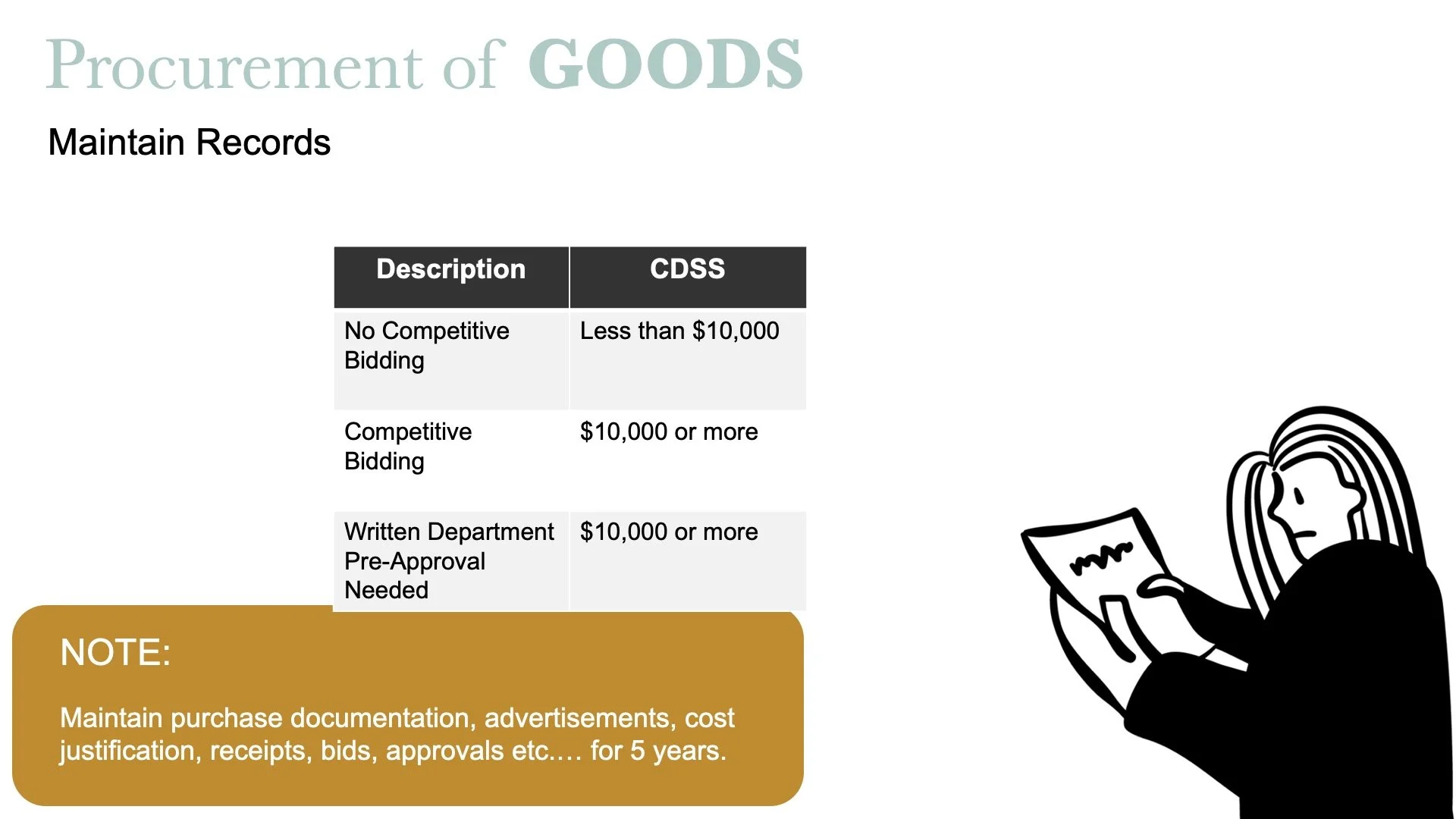
All equipment purchases, replacements & improvements must be approved in advance & have at least 3 bids or estimates if the total amount equals or exceeds $10,000 per unit cost and/or $10,000 in sum, including tax.
Although no formal bidding is required for equipment purchases, replacements and improvements that are less than $10,000, contractors must maintain purchase documentation & justification.
Subdividing or splitting equipment purchases into separate items to avoid the competitive bidding requirement is prohibited.
If 3 bids cannot be obtained, the contractor must provide documentation of the reason the bids could not be obtained.
If an item that exceeds the specific thresholds, contractors complete & submit the Equipment Purchase Approval Request (CCD 9)
NOTE: In the event a request is denied, the contractor may appeal the decision.
Purchase
After the purchase of goods or services has been determined to be an allowable expense, staff move forward with the purchase.
The contractor must purchase the goods or services from the lowest responsible bidder or estimate, along with charging to the applicable program.
Receive Order
When the product is received, a process must be in place to ensure the product is not damaged.
Once order is accepted, move forward with approving it for payment if ordered through the purchase order process.
Inventory Record
Items with an estimated useful life of more than one year must be tagged, recorded and tracked. Examples of tagging options might include adhesive labels with numbers or bar codes.
Note: If the item is received outside of the central receiving location, a property tag & instructions must be sent to the site to ensure it becomes part of the inventory.
Document the minimum requirements as outlined in the compliance indicator & Funding Terms & Conditions (type, model, serial #, etc…)
Deployment
Deliver the items to its location
Procurement of Services
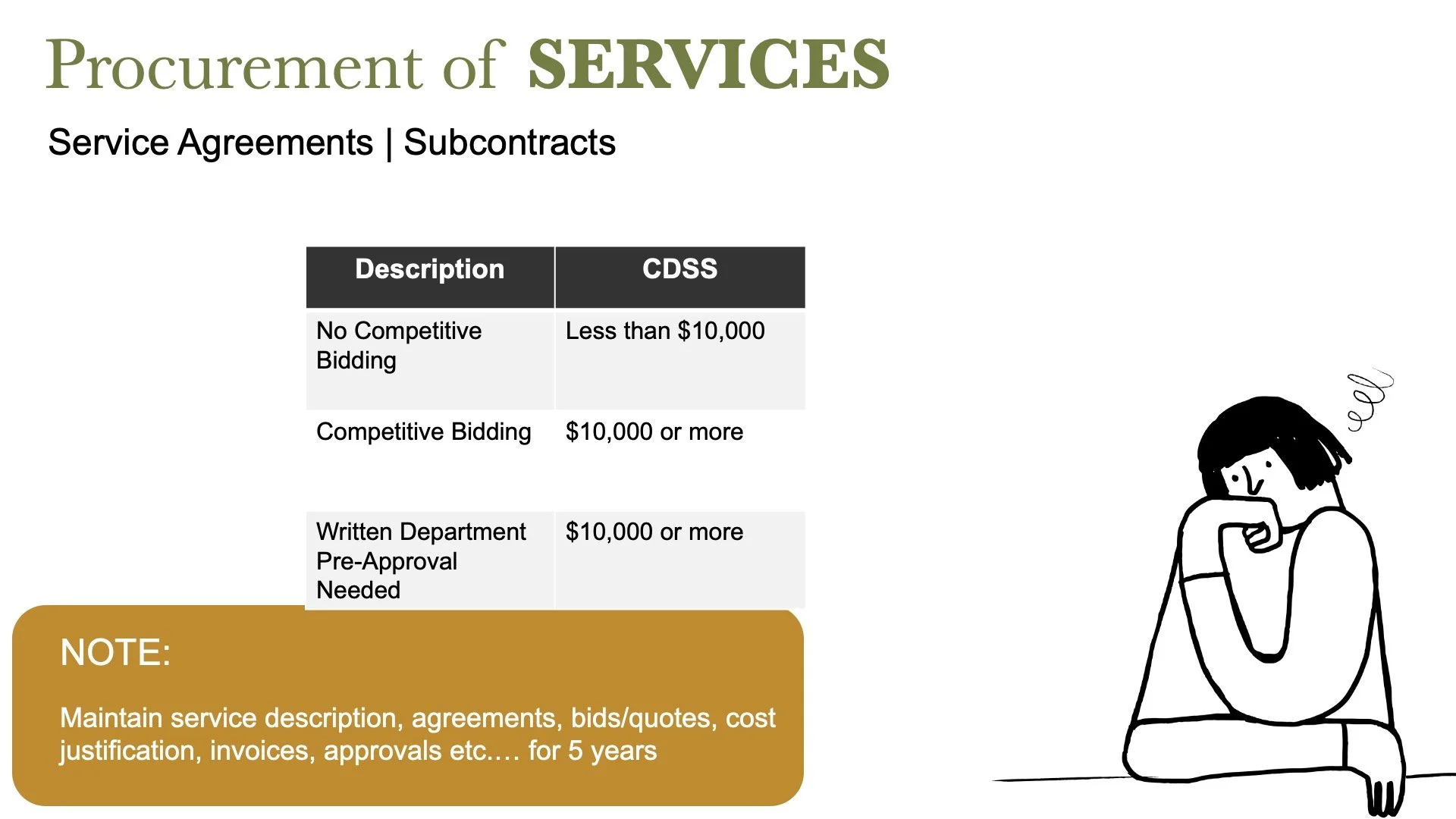
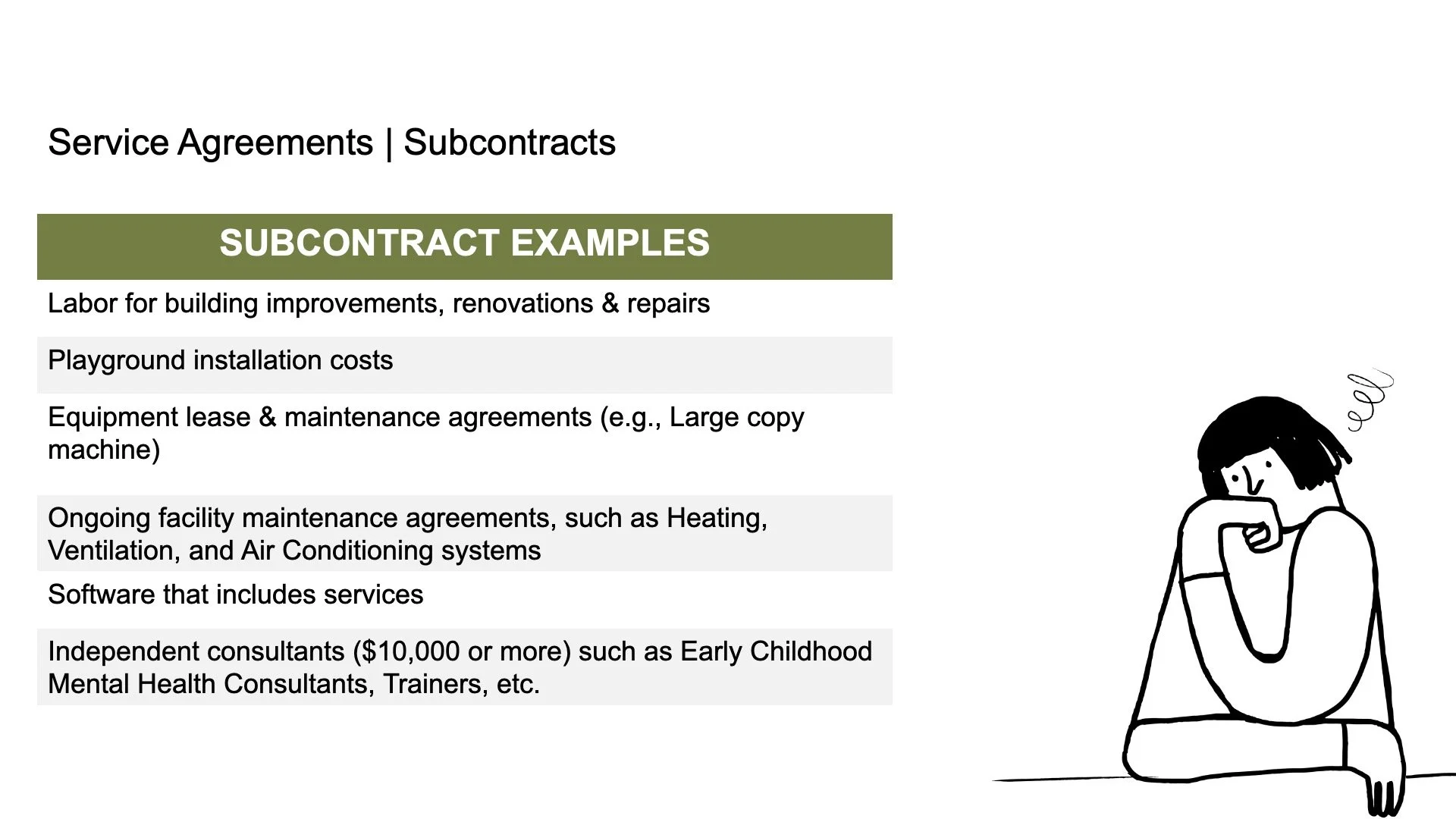
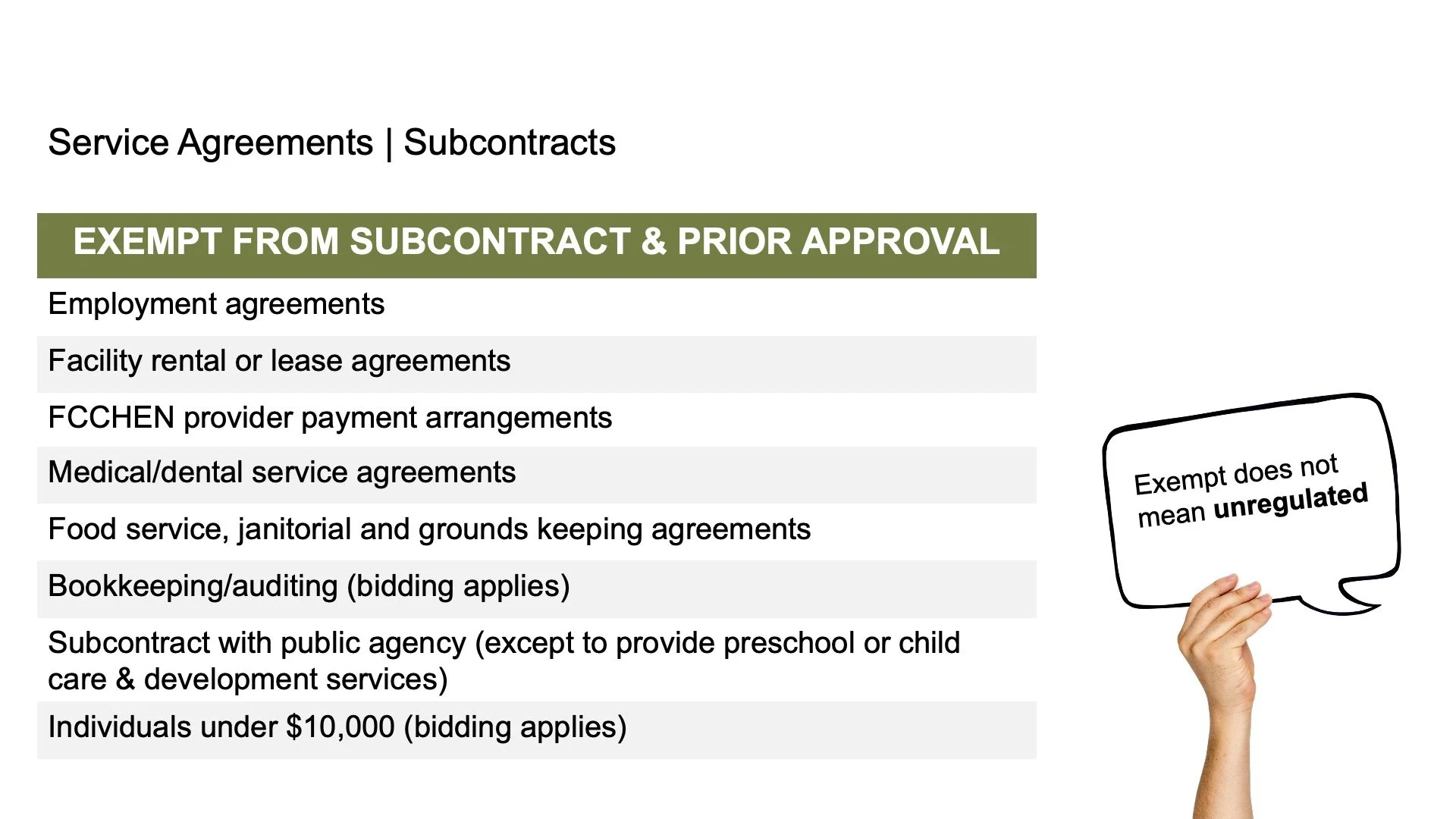
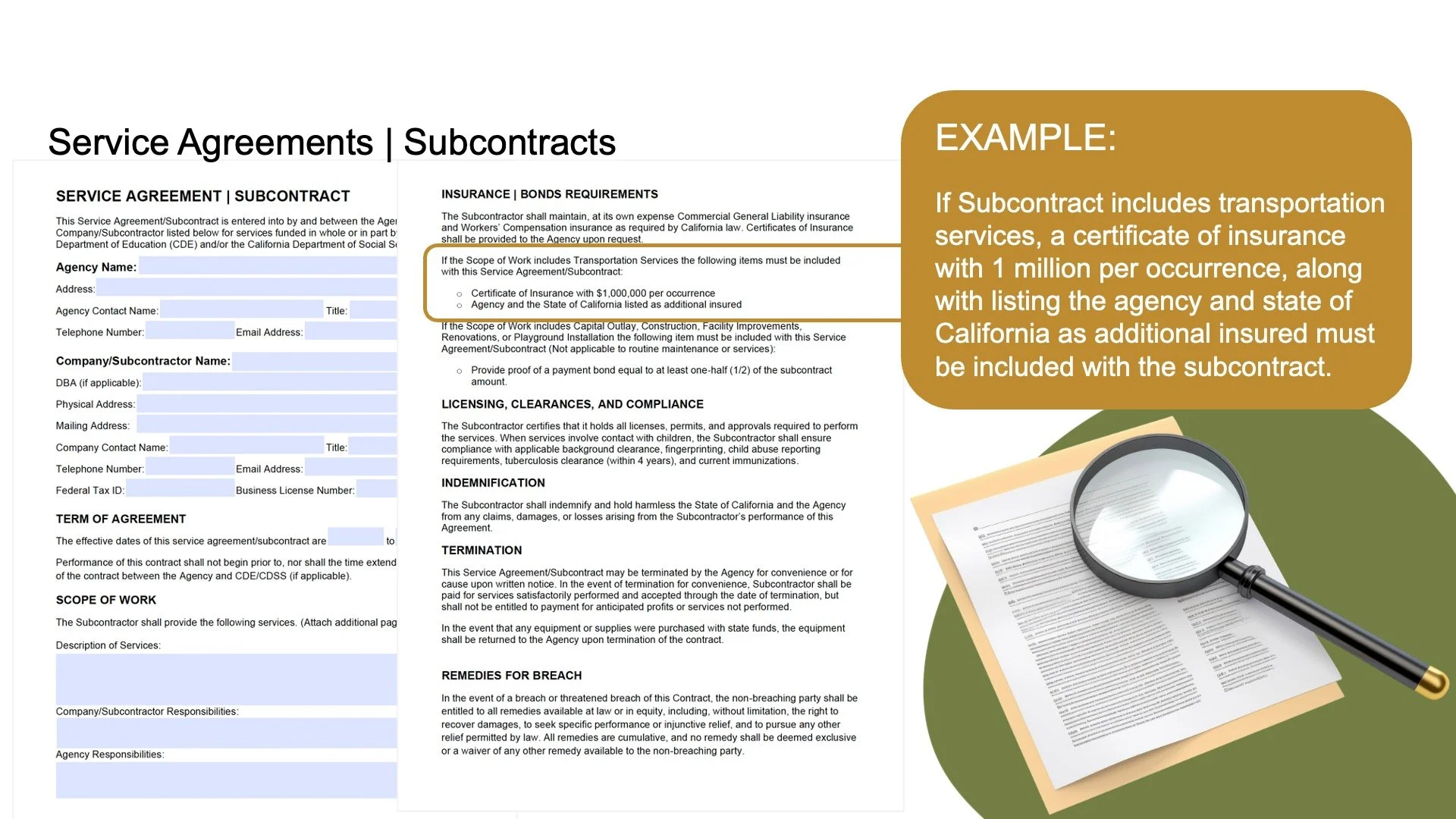
A written subcontract is required for most service agreements unless otherwise exempt.
The intent of subcontracts are to protect public funds and maintain accountability. They ensure services meet program requirements, support audit transparency and prevent the circumvention of bidding rules.
TIP: To determine if a subcontract is required, ask yourself “Once the contractor stops paying for the item, is there a tangible item that is left with the agency?” If the answer is no, then it is likely that the purchase will require a subcontract.
A subcontract is a written agreement between the contractor and any entity to perform a service on behalf of the contractor.
NOTE: The department has a list of services that are exempt from subcontracting and prior approval requirements; however, exempt does not mean unregulated. Bidding, audits and cost reasonableness may still apply.
Based on the regulations, when purchasing services, unless exempt, at least 3 bids or estimates must be obtained if the total cost equals or exceeds $10,000. If 3 bids cannot be obtained, document the reason why, such as the specific emergency, or an explanation of unique expertise of a sole source.
For subcontracted services not on the exempt list, that exceed $10,000 prior to execution, written department approval is required. Contractors must submit:
Justification Letter
Bids if a non-public agency, and
2 copies of the proposed subcontract, including line-item budget which shows the costs of services.
NOTE: For specific types of services, there may be additional requirements, which are outlined in the Program Contract or Funding Terms and Conditions.
Inventory Management (Goods)
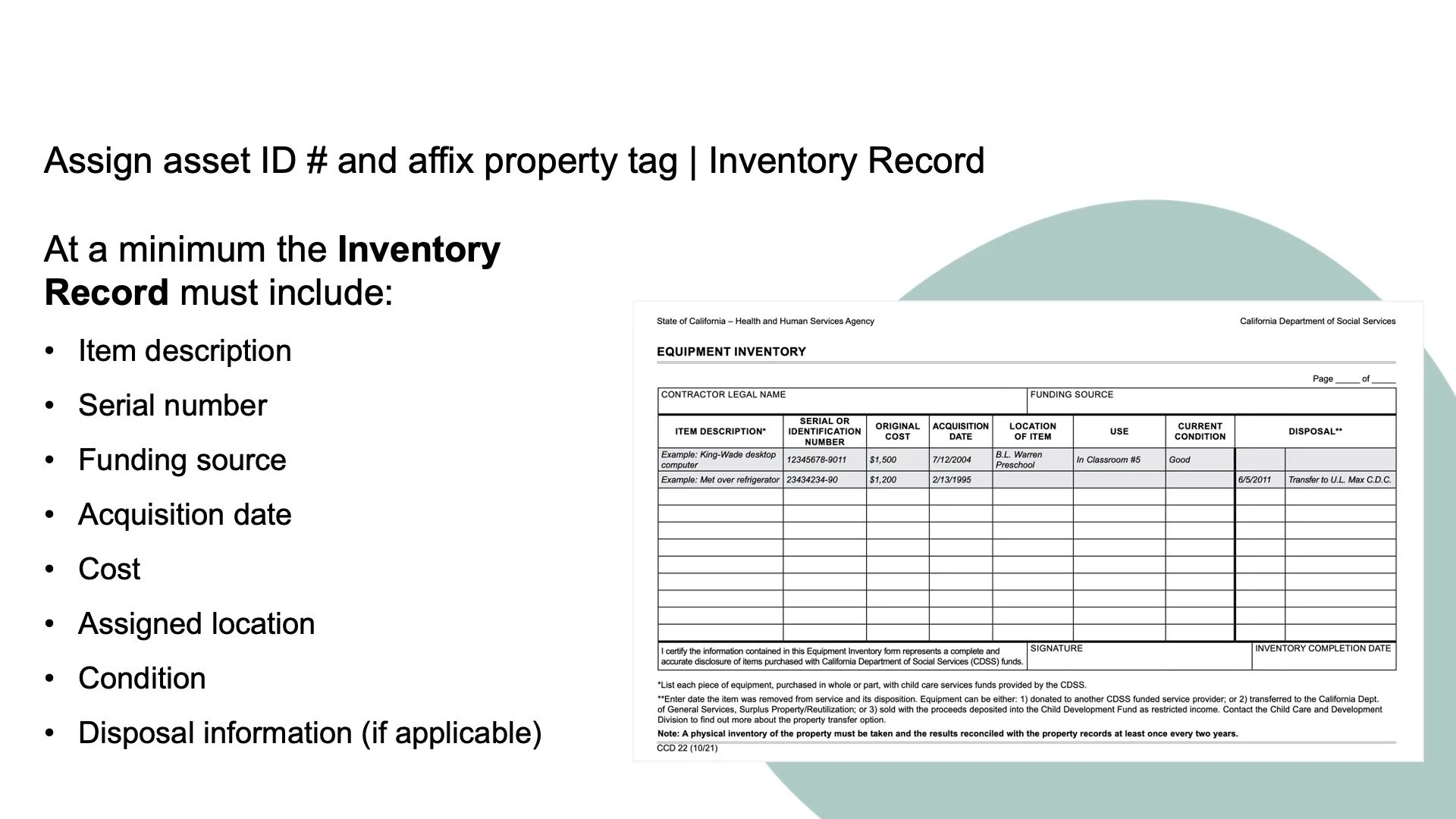
An inventory record must be maintained for each piece of equipment & non-disposable items, with an estimated useful life of more than one year, purchased in whole or in part with early learning & care contract funds.
In addition to the tagging, an inventory record must be maintained for each applicable item. At a minimum the record must include, the item description, serial number, funding source, acquisition date, cost, assigned location, condition, and disposal information, if applicable.
Most contractors have an electronic database used to maintain their inventory record that includes the minimum inventory record requirements.
If an agency does not have an electronic database, the California Department of Social Services has a template, form CCD 22, that may be used.
Monitoring & Maintenance
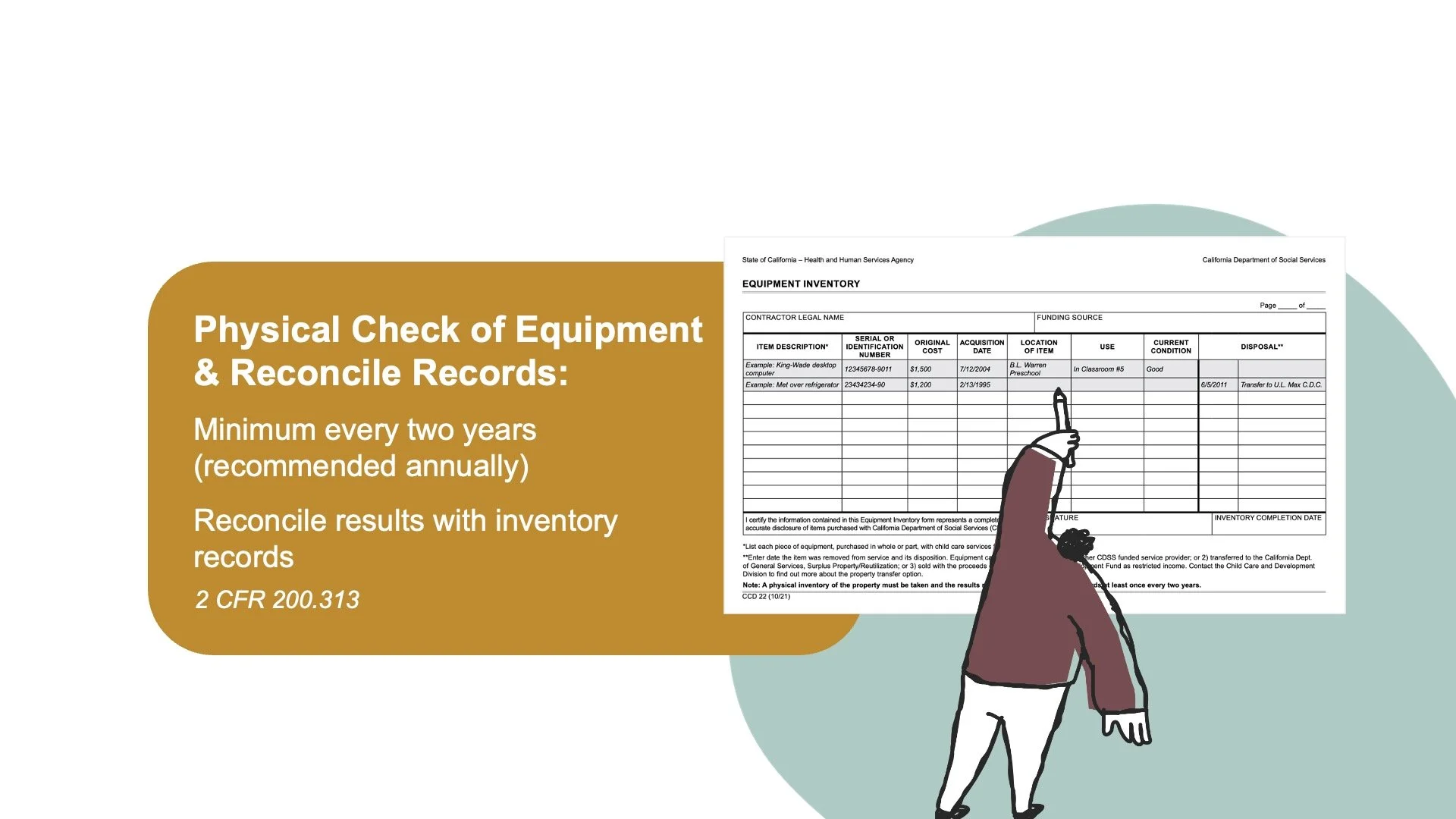
An asset control system must be in place to ensure adequate maintenance procedures are in place to keep equipment in good condition that includes taking physical inventory for the purpose of verifying the physical existence of property& equipment.
Physical inventory must be taken & results reconciled with inventory records at least once every 2 years. Any differences between quantities determined by the physical inspection & those shown in the accounting inventory records should be investigated to determine the causes of the differences.
NOTE: CDSS recommends that a physical inventory of property & equipment be taken at least annually.
What this might look like in a program:
Full inventory physical check is conducted annually.
Documentation of the most recent physical check of the inventory is maintained within the database.
To ensure adequate safeguards to prevent loss, damage, or theft of the property, the control system includes:
Alarm systems with cameras throughout each building
Staff are aware that Inventory Records must be updated within the database when items are moved from one location to the other. The Inventory Record is used to document disposal or transfer of any equipment
Business office representative conducts a random spot check quarterly
Disposal, Loss & Theft Reporting (Goods)
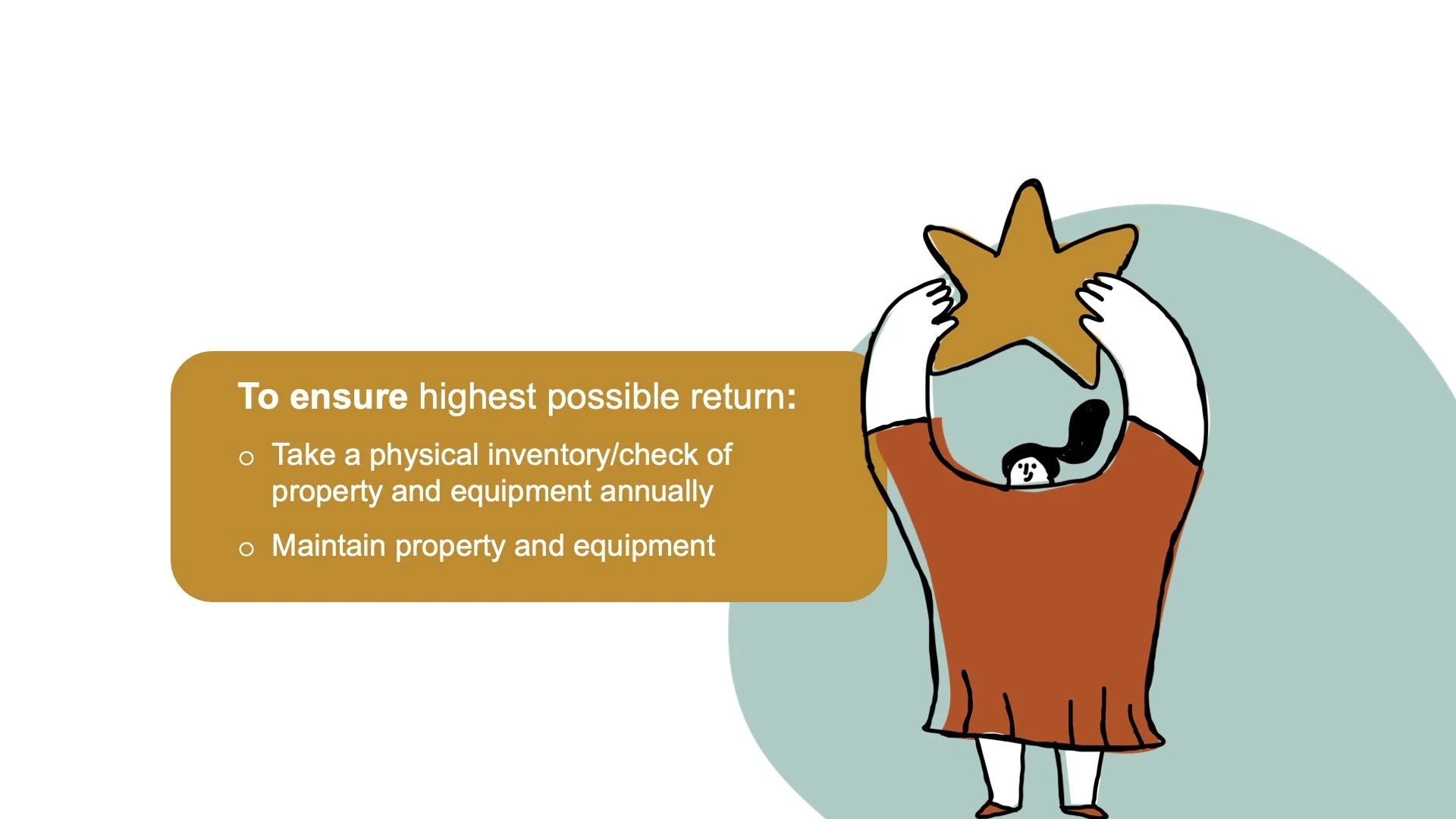
A procedure for the proper disposal of items, and system for handling items that have been lost, stolen, or damaged beyond repair should be in place.
For example, any differences between quantities determined by the physical inspection and those shown in the accounting inventory records should be investigated to determine the causes of the differences. The results of the physical inventory can be used as a basis for writing off items that have been lost, stolen, or discarded and also for adding unrecorded items.
Contractors are required to have adopted procedures regarding proper sales of items to ensure the highest possible return in the event the contractor is authorized or required to sell the item.
NOTE: If sale of equipment was originally purchased with state funds, the proceeds from the sale would be reported as other restricted income.
What this might look like in a program:
Procedure includes an annual physical inventory of property or equipment along with mainta
Complete Knowledge Check ❯
After reviewing the video lesson & sketch pad notes, it’s time to check for understanding by completing a Knowledge Check. Note that Individual Knowledge Checks will conclude with a Certificate.