

Lesson 1
Family Data File
Lesson 2
Attendance
Lesson 3
Provider Payments
Lesson 4
Family Selection & Enrollment Activities
Lesson 5
Parent Involvement & Education
Lesson 6
Health & Social Services
Lesson 7
Expulsion & Suspension
Lesson 8
Community Involvement
Lesson 9
Site Licensure
Lesson 10
Adult-Child Ratios
Lesson 11
Environment Rating Scale
Lesson 12
Nutritional Needs
Lesson 13
DRDP & Education Program
Lesson 14
Parent Survey
Lesson 15
Qualified Director
Lesson 16
Staff Development/
Provider Support
Lesson 17
Refrain from Religious Instruction
Lesson 18
Inventory Records
Lesson 19
Program Self-Evaluation
Lesson 20
FCCHEN Provider Participation
Lesson 21
Contractor Parent Policies
Lesson 22
Fiscal Essentials: CFCC Contract Type
Lesson 23
Fiscal Essentials: CCTR Contract Type
Lesson 24
Fiscal Audits
Lesson 25
Child Development Data Reporting

Compliance Indicator
Families with children enrolled in the program have met the eligibility requirements of that contract, and the required documentation is complete. A family data file has been established for each family. The eligibility duration is for no less than 24 months for the initial certification and recertification.
Regulations/Reference
CCD Program Instrument: I. Family Files CCD 01
Welfare & Institutions Code: 10260, 10271, 10271(h), 10271.5, 10271.7
Title 5: 18078, 18081, 18082.2, 18083, 18083.1, 18084, 18084.1, 18085, 18090, 18091
Monitoring Review Evidence
Application for Services & Information Verification
Records of Eligibility, Residency & Family Size
Records of Verification of Eligibility Information
Written Materials for Parents
Watch Video Lesson ❯
Accessibility Note: The complete accessible content is available in the video and transcript below. The transcript can be accessed using the transcript option in the video player controls. The slide deck is provided for visual reference and may not be fully accessible.
Video Description: This video explains most eligibility criteria that a family enrolled in a CDSS program may qualify under, except for income eligibility, which is covered in Eligibility Part 2.
Video Description: This video explains eligibility criteria, income eligible, for a family enrolled in a CDSS program.
Sample Forms/Tools ❯
Calculators
Eligibility Forms
File Checklists
Parent Enrollment Checklists/Tools
Parent Handbook
Review Sketch Pad Notes ❯
Eligibility (Part 1)
Once a family establishes eligibility, they will remain eligible & receive services for not less than 24 months. With that said, it’s very important to ensure you “get it right from the get-go” when it comes to determining a family’s eligibility for services, or you could find yourself living with a file error for 24 months.
Age Eligibility

The chronological age, or actual age, of a child is used to determine age eligibility. The specific ages of the children served are written into your program grant applicationsIn general, at the time of certification children enrolled in CDSS programs must be:
12-years old or younger
Up to age 21 with a documented disability
Eligibility Criteria

According to the regulations, eligibility is based on either child or family eligibility.
Child Eligibility
Child protective services
At-risk of abuse, neglect or exploitation
Family Eligibility
Homelessness
CalWORKs Cash Aid Recipient
Receiving Benefits from Certain Governmental Program
Income Eligible (85% SMI)
What this might look like in a program:
Family provides documentation of eligibility in 1 or more category
Agency representative reviews documentation to determine if it meets eligibility requirements
Child Protective Services

Children receiving Child Protective Services (CPS) through the county welfare department may receive child care & development services if referred by a county child welfare services worker.
Referral Letter must include:
County CPS letterhead
Date
Statement certifying that the child is receiving child protective services & that child care & development services are a necessary component of the child protective services plan
Name & birth date of each child being referred
Frequency of needed child care services that includes the number of days per week & number of hours per day child care is needed
Probable duration of the child protective plan
Name, address, phone number & signature of the person making the referral
NOTE: If no income waiver, documentation of monthly income is required to determine family fee.
Sample: CPS Referral Letter >
At-Risk

Children at-risk of abuse, neglect, or exploitation, & referred from a legally qualified professional in a legal, medical, or social services agency, a local educational agency liaison for homeless children & youths, a head start program, or an emergency shelter may receive child care & development services.
Referral Letter must include:
Date
Statement by a legally qualified professional that states: The child is at risk of abuse & neglect & that child care & development services are needed to reduce or eliminate that risk
Name & birth date of each child being referred
Frequency of needed child care services that includes the number of days per week & number of hours per day child care is needed
Probable duration of the at-risk situation
Name, address, phone number & signature of the person making the referral
NOTE: If no income waiver, documentation of monthly income is required to determine family fee.
Sample: At-Risk Referral Letter >
Homelessness

The definition of homelessness aligns with the definition of "homeless children" that is in the McKinney-Vento Homeless Assistance Act. The McKinney-Vento Act defines homeless children & youth as "children that lack a fixed, regular & adequate nighttime residence.” And includes one of the following sub parts:
Sharing housing of other persons due to loss of housing, economic hardship, or a similar reason
Living in motels, hotels, trailer parks or camping
Emergency or transitional shelters or abandoned in hospital
Primary nighttime residence that is a public or private place not designed for or ordinarily used as a regular sleeping accommodation for human beings
Living in car, park, public spaces, abandoned buildings, substandard housing, bus or train stations, or similar settings
Migratory children who qualify as homeless because they are children who are living in similar circumstances listed above
Either a written parental declaration that the family is experiencing homelessness OR written referral from an emergency shelter or other legal, medical or social services agency is needed to document eligibility of homelessness.
NOTE: Documentation of monthly income is collected for the purpose of prioritization & determination of family fee
Sample: Parental Declaration of Homelessness Form >
Sample: Homeless Referral Letter >
Current Aid Recipient

If the basis of eligibility is a current cash aid recipient, the parent must provide documentation of CalWORKs cash-aid, unless the contractor has other means of obtaining verification.
Examples of documentation may include:
Notice of action from the welfare department
Receipt of CalWORKs Cash Aid
Verification of Benefits
NOTE: Documentation should be for the month proceeding certification or recertification
Additionally, documentation of income is collected for the purpose of prioritization. Alternatively, the family may report their cash aid under the receiving benefits from certain governmental program eligibility category and use the governmental program application income for verification purposes.
Receiving Benefits from Certain Governmental Program

A family is categorically eligible to receive child care & development services if a member in the household meets either of the two following criteria:
Member of the household has been certified as eligible to receive benefits or services from one of the following:
CalWorks
Medi-Cal
CalFresh
California Food Assistance Program
California Special Supplemental Nutrition Program for Women, Infants, and Children (WIC)
The Federal Food Distribution Program on Indian Reservations
Head Start
Early Head Start
Contracting agency has determined a member of the household eligible for Head Start or Early Head Start
Documentation that demonstrates family is certified for a governmental program:
Enrollment Documentation in any of the means-tested governmental programs referenced above (Example: Notice of Action | Receipt of Aid | Verification of Benefits) AND
Copy of Governmental Program Application OR
If not available, a Self-Declaration of Income indicating that they do not have access to the application, and to the best of their recollection, the income declared on the governmental program application
NOTE: Income declared on governmental program application is used for the purpose of prioritization & determination of family fee
Eligibility (Part 2): All About Income
Income Eligible
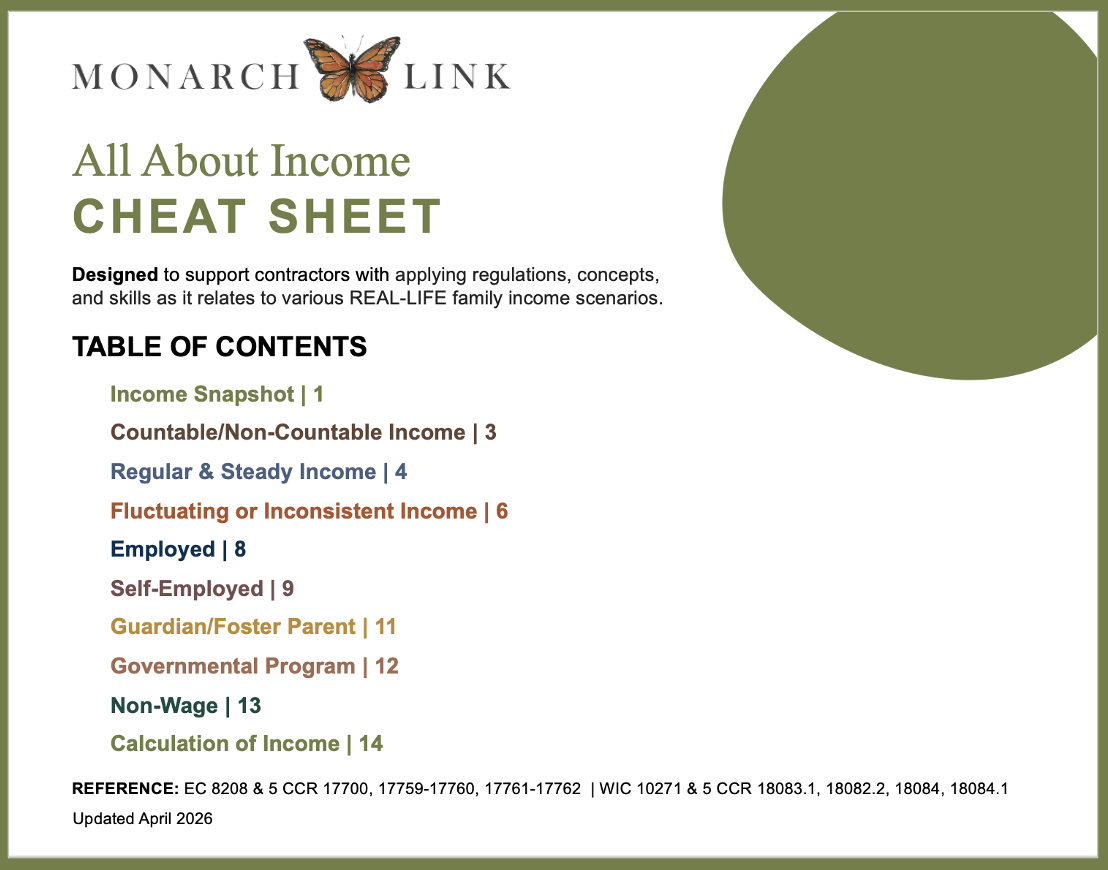
The most common and complex eligibility category is income eligibility. Documenting and calculating a family’s income can be an overwhelming task. With that in mind, it is important to understand the why, when, and what of income. In this section, we will break down income documentation requirements, review different family and income situations, and walk through how to accurately calculate income step-by-step.
The cheat sheet was designed to support contractors with applying regulations, concepts, and skills as it relates to various REAL-LIFE family income scenarios.
Income Snapshot
WHY is income collected?

Copies of the total countable income, along with an Income Calculation Worksheet are required & used in the family data file for various reasons.
Income is used to:
Determine income ranking for many of the admission priorities.
Determine income eligibility criteria
Assess a family fee
For an employed parent, income serves as the first step in determining a family’s level of need.
WHEN is income collected?
Income is collected:
Certification
Recertification
When a parent requests to have their family fee or an employed parents need reassessed
When an income eligible family reports that their income exceeds the income threshold during their certification period.
WHAT income is collected?

The income collected is dependent on the family’s eligibility category.
Means-Tested Government Program: Use the income declared on the government program application.
CPS or At-Risk: When the referral specifies that the family is exempt from paying a family fee, no income documentation is required.
All Other Eligibility Criteria (including homelessness, current aid recipient, and income eligibility): Documentation of all countable income must be collected for the purpose of prioritization, determining income eligibility, and assessing a family fee or level of employment need.
Documentation of Income
Adjusted Monthly Income
The regulations allow income to be adjusted when a parent is paying child support. To adjust a parent’s income, take the total countable income minus verified child support payments.
Countable Income
The parent shall obtain & provide documentation of the family's total countable income for the purposes of determining whether a family is income eligible &/or assessing the appropriate family fee, as applicable.
The parent(s) shall provide documentation of total countable income for all the individuals counted in the family size.”
1.Gross wage or salary, commissions, overtime, tips, bonuses, gambling or lottery winnings
2.Wages for migrant, agricultural, or seasonal work
3.CalWORKs cash aid
4.Gross income from self-employment less business expenses with the exception of wage draws
5.Disability or unemployment compensation
6.Worker’s compensation
7.Spousal support, child support from the former spouse or absent parent, or financial assistance for housing costs or car payments paid as part of or in addition to spousal or child support
8.Survivor (i.e., SSA) and retirement benefits
9.Dividends, interest on bonds, income from estates or trusts, net rental income or royalties
10.Rent for room within the family’s residence
11.Financial assistance received for the care of a child living with an adult who is not the child’s biological or adoptive parent
12.Veteran’s pension
13.Pension or annuities
14.Inheritance
15.Allowances for housing or automobiles provided as part of compensation
16.Insurance or court settlements for lost wages or punitive damages
17.Net proceeds from the sale of real property, stocks or inherited property
18.Other enterprise for gain
Non-Countable Income
Non-countable income is income of individuals counted in the family size that shall be excluded when calculating the family’s adjusted monthly income.
1.Earnings of child under eighteen (18) years
2.Loans
3.Grants or scholarships to students for educational purposes
4.Federal Supplemental Assistance Program (CalFRESH/SNAP) or Women, Infants and Children (WIC) benefits or other food assistance
5.Earned Income Tax Credit or tax refund
6.Foster care grants, payment or clothing allowances for children placed through child welfare services
7.Relative Caregiver Funding Program
8.Guaranteed Income Payments received by an individual (EC 8213)
9.GI Bill entitlements, hardship or hazardous duty, hostile fire or immediate danger pay
10.Adoption assistance payments
11.Non-cash assistance or gifts
12.All income of any individual counted in the family size who is collecting federal Supplemental Security Income (SSI) or State Supplemental Program (SSP) benefits
13.Insurance or court settlements including pain and suffering and excluding lost wages and punitive damages
14.Reimbursements for work-required expenses that include uniforms, mileage, or per diem expenses for food and lodging
15.Business expenses for self-employed family members
16.When there is no cash value to the employee, the portion of medical and/or dental insurance documented as paid by the employer and included in gross pay
17.Disaster relief grants or payments, except any portion for rental assistance or unemployment
18.AmeriCorps Volunteers In Service to America (VISTA) and Federal Emergency Management Agency (FEMA) stipends, room and board, and grants
19.CSPP ONLY: Basic Allowance for Military Housing (BAH) when part of compensation. (NOTE: CSPP Contractor must obtain written approval from the Department prior to waiving)

REGULAR & STEADY INCOME
Total countable income from either month of the 2-month window immediately preceding certification
For income eligibility, use any 4 weeks within the preceding 2 months
Weekly - Pay is received once per week (need 4 check stubs)
Every Two Weeks - Pay cycle is usually 14 days. Example: Every other Friday (need 2 check stubs)
Bi-Monthly - Usually 15 days or longer. Example: Pay received 5th and 20th (need 2 check stubs)
Monthly - Pay is received once per month
NOTES:
For the collection period, you will look at the actual pay date. When did the parent receive the money.
To determine frequency, look at the pay period. This will help you determine how many paystubs are needed.

FLUCTUATING OR INCONSISTENT INCOME
For fluctuating or inconsistent income, additional proof of income is required for a longer period of time.
Average the parent’s income from preceding 2 to 12 months
Migrant
Agricultural
Seasonal
Inconsistent or unstable employment or self-employment
Intermittent
NOTE:
When enrolling a family in both State Preschool and a CDSS program, average preceding 12 months as this is the most stringent.

EMPLOYMENT INCOME
STEP 1: the parent must provide a release authorizing the contractor to contact the employer or employers that includes, to the extent known, the employer’s name, address, telephone number and usual business hours. A generic authorization is NOT SUFFICIENT. The regulations are very clear that the release must be specific to the employer, and contain these elements.
STEP 2: Employed parents MUST provide proof of employment income, such as:
Payroll check stubs, or
Independently drafted letter from the employer
Other record of wages issued by the employer
When the employer refuses or fails to provide requested documentation or when the parent states a request for documentation would adversely affect the parent's employment, the parent must obtain and provide other means of verification that may include:
List of clients and amounts paid
The most recently signed and completed tax returns, quarterly estimated tax statements, or
Other records of income to support the reported income, along with a self-certification of income

SELF-EMPLOYMENT INCOME
STEP 1: Parent provides a combination of documentation necessary to establish income, including business revenue & expenses.
Regular & steady revenue: Total revenue minus business expenses from either month of the 2-month window immediately preceding certification
Inconsistent revenue: Average the total revenue minus expenses from preceding 2 to 12 months
STEP 2: Staff must verify documentation provided to ensure the business is legitimate. Documentation must consist of a self-certification of income, and as many of the following types of documentation as reasonably necessary to determine income, such as:
A letter from the source of income
Copy of the most recently signed and completed tax return with a statement of current estimated income for tax purpose, or
Other business records, such as ledgers, receipts, or business logs.
STEP 3: Staff calculate self-employment income.
Once the self-employed parent has provided proof of income, the regulations state that the contractor shall make a record of independent verification on the cost for services provided by the parent. There are several choices to do this, such as contacting clients or parent’s advertisement.
NOTE: Wage draw is NOT an expense (Business owner takes funds out of business for personal use)
What this might look like in practice:
Knowing what documentation is required for a self-employed parent can be overwhelming.
The Declaration of Self-Employment/Income form is a great source to determine what a parent should provide based on their type of business.
Step back & think, for this type of business what should I request in order to verify the following:
Legitimate business
Records of revenue
Records of expenses
Within the All About Income Cheat Sheet there are examples of what to collect based on the business type.

GUARDIAN/FOSTER PARENT CHILD INCOME
A foster parent or guardian’s income is not counted. For income eligibility, when a child and that child’s siblings are living in a family that does not include their biological or adoptive parent, only the child and related siblings adjusted monthly countable income is counted.
If the child has zero income, the guardian can complete a Self-Certification of Income form declaring that they receive no income to care for the child
Examples of Child Income:
CalWORKs cash aid
Child disability benefits that are not SSI/SSP benefits
Child support, if received by
the guardianSurvivor benefits
Foster care grants, payments or clothing allowance (non-countable income)
Financial assistance received for the care of a child living with an adult who is not the child’s biological or adoptive parent
NOTE:
A guardian/foster parents' income might be included in the family data file for the purpose of establishing their need for service hours (NOT eligibility).
If this is the case, ensure the family data file is very clear.
For example, in the file, record Need for Services at the bottom of the guardian’s income documentation to ensure need documentation is separate from eligibility documentation.

GOVERNMENTAL PROGRAM INCOME
A family is categorically eligible to receive child care & development services if a member of the household has been certified as eligible to receive benefits or services from one of these programs:
CalWORKs
Medi-Cal
CalFresh
California Food Assistance Program
WIC
Federal Food Distribution Program on Indian Reservations
Head Start or Early Head Start
Documentation that demonstrates family is certified for a governmental program must include:
Enrollment Documentation in any of the means-tested governmental programs referenced above (Example: Notice of Action | Receipt of Aid | Verification of Benefits) AND
Copy of Governmental Program Application OR
If not available, a Self-Declaration of Income indicating that they do not have access to the application, and to the best of their recollection, the income declared on the governmental program application
NOTES:
The income declared on governmental program application is used for the purpose of prioritization & determination of family fee.
If the income was an annual income, then divide it by 12.

NON-WAGE INCOME
There are many different types of non-wage income. Some non-wage income is countable, while other types are non-countable.
What this might look like in practice:
When a parent is receiving child support but there is no court order in place, and only an informal agreement exists between the parents, the parent may provide a personal letter, copy of a check, record of direct deposit, or a self-declaration of child support income
Calculation of Income
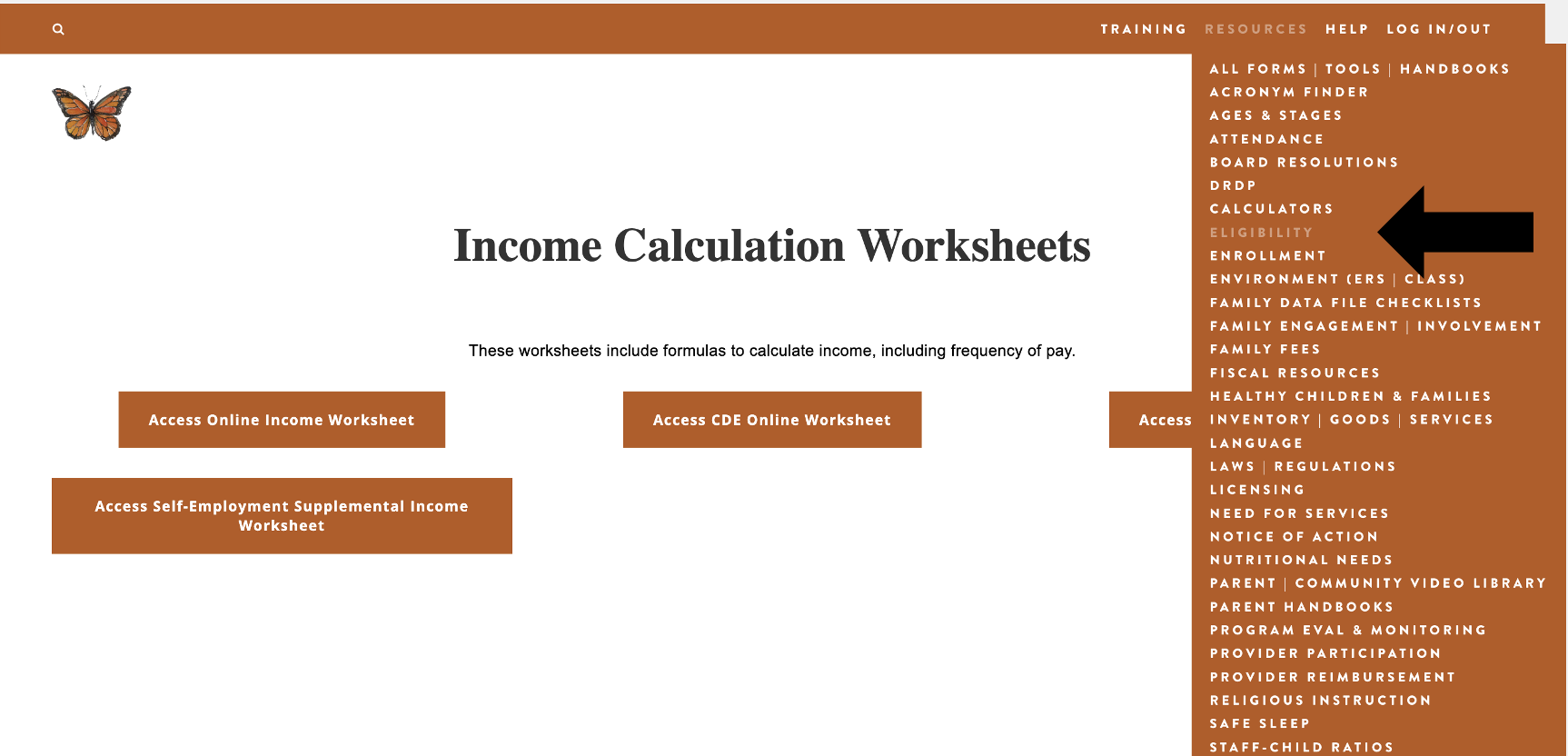
In addition to documentation of income, the file must contain an income calculation worksheet.
The worksheet must specify the frequency and amount the payroll check stubs provided by the parent and of all sources of income.
The contractor must retain copies of the documentation of total countable income
Notice to Income Eligible Family

When a family is certified as “Income Eligible”:
Contractors must notify parents at the time of initial certification & at recertification of their income threshold, based on their family size
Contractors must inform the family of the requirement to report within 30 days if their income exceeds this dollar amount
When parent reports that their income exceeds the exit threshold, this triggers the contractor to recertify the family. The contractor must then re-determine the family’s ongoing eligibility for child care services
Download Sample: Parent Notification to Report Income Over SMI form
Complete Knowledge Check ❯
After reviewing the video lesson & sketch pad notes, it’s time to check for understanding by completing a Knowledge Check. Note that Individual Knowledge Checks will conclude with a Certificate.